Zocdoc will now make a clinic bookable inside Google Gemini and Amazon's health AI through one calendar connection, free to join, paying only when it brings a new patient
September 23, 2026 · 4 items
Zocdoc will now make a clinic bookable inside Google Gemini and Amazon's health AI through one calendar connection, free to join, paying only when it brings a new patient
HIT Consultant · September 22, 2026Patient acquisition
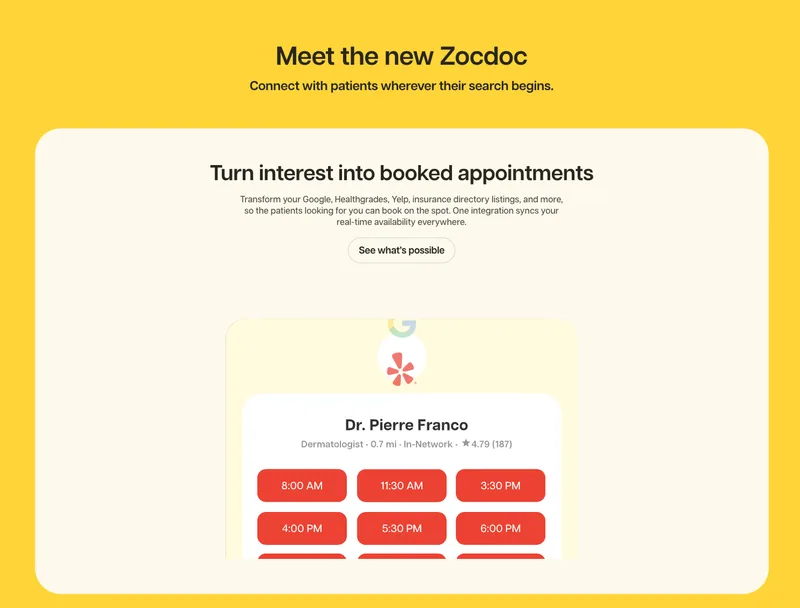
Zocdoc's new Care Access Network takes a provider's real-time availability off Zocdoc.com and syndicates it to Google Gemini, Amazon Health AI, Yelp, Healthgrades, Blue Shield of California, search engines and insurer directories. One integration covers all of them.
New pricing: free to join, no fee when an existing patient books or when someone searches for a clinician by name. The practice pays a one-time fee only when Zocdoc brings a net-new patient and the booking is completed. It syncs with 175+ EHR and practice-management systems.
For independent practices, Zocdoc adds white-label intake, insurance eligibility checks, and branded website booking widgets (it claims a 25–30% lift in bookings from the practice's own site). It also adds Zo, an AI phone assistant that answers the line 24/7 and books from the live calendar.
Zocdoc's own survey: 69% of patients looking for a new doctor check several channels, more than 1 in 3 have switched providers over scheduling friction, and 43% would switch for easier digital booking. :warning: Every figure is company-reported. The Gemini booking link itself dates to Aug 12. What's new this week is the multi-channel network and the pricing.
Why it matters for an independent practice: This is the "bookable inside the AI answer" problem MMR has been circling, now sold as a product. Upside: a clinic can be bookable in Gemini next month without building anything. Cost: the intermediary owns the new-patient moment and charges for it. And the "new vs. existing" line decides who gets billed for a patient the clinic's own SEO and reviews produced. Before any client signs up, check how Zocdoc tells a "new" patient from one who found the clinic through MMR's work. Also decide whether the clinic's own site should get the booking widget first. HIT Consultant — Zocdoc Launches Care Access Network to Make Providers Bookable Across Gemini, Amazon Health AI, and Search Engines
Google now says in writing that if a clinic doesn't reject a stranger's edit to its Business Profile within four days, Google may publish it, and sometimes won't ask at all
Search Engine Roundtable / Barry Schwartz · September 23, 2026Patient acquisition
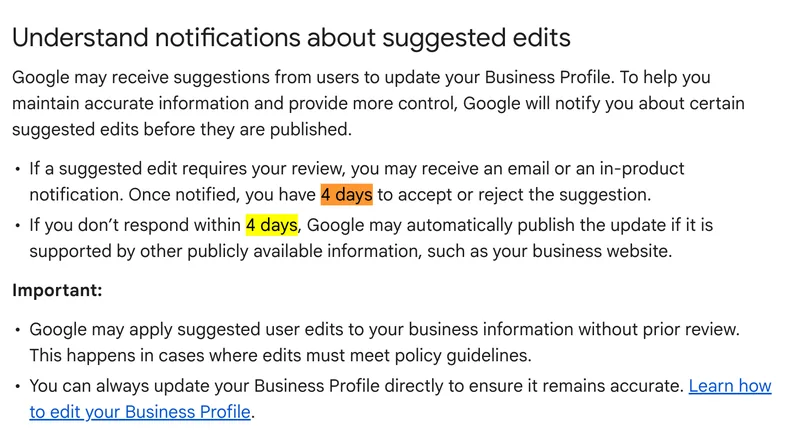
Google's help document has a new section, "Understand notifications about suggested edits." It says that when a user suggests an edit that needs review, the owner may get an email or an in-product notification, and "you have 4 days to accept or reject the suggestion."
After that: "If you don't respond within 4 days, Google may automatically publish the update if it is supported by other publicly available information, such as your business website."
And the part that matters most: "Google may apply suggested user edits to your business information without prior review. This happens in cases where edits must meet policy guidelines." So some edits never reach the owner first.
This is a documentation change, dated by the help-doc update. It is not a product announcement.
Why it matters for an independent practice: Hours, phone number, address and categories are what a patient acts on. A wrong phone number or a "permanently closed" flag quietly costs bookings. Three moves for every client profile: (1) make sure the notification email goes to an inbox someone checks daily, not a former office manager's. (2) Set a 48-hour internal rule for reviewing suggested edits, so the 4-day window is never close. (3) Keep the clinic website's hours, NAP (name, address, phone) and services matching the profile exactly. Google says it checks edits against "publicly available information, such as your business website," so the website decides which version wins. Search Engine Roundtable — Google Business Profiles Gives You Four Days To Reject User Suggested Edits (Candidate source, second day running. Yesterday's item was its first.)
Gallup: 74% of Americans who know about AI say it makes them worried, the highest of 37 countries. Even 68% of daily users are worried.
TechCrunch · September 23, 2026Buildable AI
Gallup, commissioned by Microsoft, polled about 1,000 people in each of 37 countries. Fieldwork ran April to July. The project will eventually cover 140 countries (India, Australia and Malaysia are not in these first results).
The U.S. sits at the anxious end of the chart. 74% of AI-aware Americans report worry, and only 36% expect AI to mostly help the country. Among Americans who use AI daily, about 68% are still worried, and worry runs higher among less frequent users.
Other wealthy Western countries look similar. In Canada, 29% use AI daily and 64% of those aware of AI say it worries them. Gallup's summary, reported elsewhere: positive feelings lead in 34 of 37 countries, but not in the U.S.
The takeaway from TechCrunch's read: using AI is not the same as trusting it. Adoption numbers can't be read as enthusiasm.
Why it matters for an independent practice: This is the mood of the patient calling the front desk, and U.S. patients bring more of it than anyone else surveyed. For a practice rolling out an AI receptionist, scribe or chatbot, "patients use ChatGPT anyway" is not permission. Disclosure is. Say plainly when a patient is talking to AI, make "talk to a person" one step away, and put a short "how we use AI" note on the website. For MMR, that note is a trust asset that competitors quietly automating their front desk won't have. TechCrunch — Even Americans who use AI every day are worried about it
A 10-minute no-code build: score 100 sales leads for fit in under a minute for $0.002, using a "decision model" that can't write a sentence, with Claude Code handling the rest
Automate with Marc | AI Automation · September 23, 2026Buildable AI
Dated from the watch page's upload stamp: 2026-09-23T07:44:57-07:00, under a day old at run time. It had fewer than 100 views when checked.
The tool is Jev, a new "decision model" from TypeSafe AI, reached through OpenRouter. It isn't a chat model. You give it data plus a question with fixed answers (yes/no, pick from a list, score 1–4), and it returns an answer with a confidence level.
The build: Claude Code drafts four scoring criteria, waits for approval, then scores a 100-lead list for ideal-customer fit and outputs a CSV with a confidence column. Reported run cost: $0.002. Marc's own spot check puts it around 90–95% in line with his scoring, and he left the wrong rows in on purpose.
:warning: Stated honestly in the video: TypeSafe is a week old, and the speed and cost numbers are the vendor's own tests. His advice is to treat the confidence column and a "needs review" pile as part of the workflow. He adds that the API key belongs in a `.env` file, never pasted into the chat.
Why it matters for an independent practice: Zero medical content, which is the preferred shape. The pattern (cheap fixed-answer sorting, low-confidence rows go to a human, Claude does the writing) matches practice ops almost exactly. Examples: sort web-form inquiries into "new patient / existing / billing / not a fit." Triage inbound messages for urgency. Tag reviews by theme. For MMR, score a lead list by how well each prospect fits a regen clinic. The review pile is what keeps it safe: nothing clinical gets decided by the cheap model, it only decides what a person looks at first. YouTube — Automate with Marc: Jev + Claude Code For Sales (100 Leads for $0.002) (Candidate source: first item from this channel since it was proposed Sep 21.)