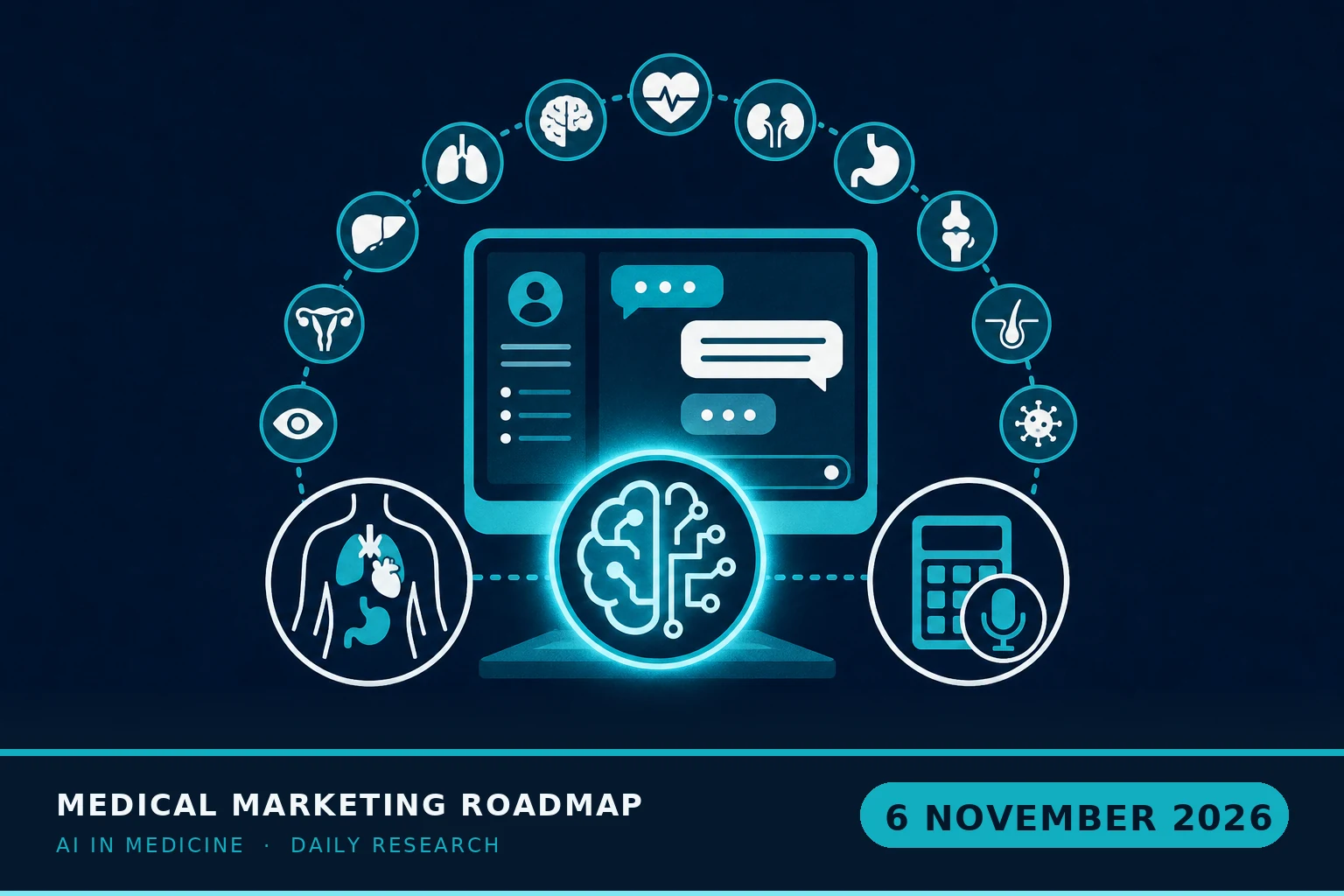
Mayo Clinic Platform launched an EHR-embedded clinical decision support tool with chat across 35+ specialties and 22 voice-accessible calculators
November 6, 2026 · 5 items
Mayo Clinic Platform launched an EHR-embedded clinical decision support tool with chat across 35+ specialties and 22 voice-accessible calculators
Healthcare IT News · November 5, 2026Practice operations
The AI-enabled CDS software is available to Mayo clinicians and to professionals at organizations participating in Mayo Clinic Platform's healthcare provider programs, and is designed to integrate directly into several different EHR workflows.
Capabilities named: a chat tool covering more than 35 specialties that surfaces case studies and peer-reviewed literature, plus more than 20 'clinical calculators' — 22 spanning cardiology, oncology, hepatology and endocrinology — accessible by voice dictation.
Dr. Gelareh Zadeh, chair of Mayo's Department of Neurosurgery and CMO of Mayo Clinic Platform, told the health system's newsroom the tool is "designed to assist healthcare professionals as they make patient care decisions; it does not replace clinical judgment," and that Mayo physicians gave feedback on the tools during development.
COO Maneesh Goyal framed the problem as search friction: clinicians have "a vast amount of medical knowledge" but finding the relevant piece "takes valuable time."
Why it matters for an independent practice: The design pattern to copy is not the model — it's the placement. Mayo put the answer where the decision happens (inside the EHR, callable by voice) instead of making the clinician leave the chart. For an independent practice evaluating any AI knowledge tool, the buying question is now: does it live in my workflow, and does the vendor publish which specialties and which calculators it actually covers?
FDA issued final guidance requiring cell and gene therapy makers to build a 'Potency Assurance Strategy' across the full product lifecycle, replacing its 2011 potency testing guidance
FDA · November 2, 2026Regenerative medicine
The final guidance, Potency Assurance for Cellular and Gene Therapy Products, asks manufacturers to verify before a product reaches a patient that every batch meets a defined potency standard — and to carry that verification from early-phase IND submissions through BLA approval and post-market monitoring.
Named scope includes controls for raw-material variability, in-process testing, and lab tests confirming each batch is biologically active in a way matching its intended therapeutic effect; it also addresses short-shelf-life products, viral vector gene therapies, and patient-specific therapies.
CBER Director Karim Mikhail, B. Pharm., M.S.: "Patients who receive cellular and gene therapies are often battling serious or life-threatening conditions... and they deserve the assurance that the product administered to them will perform as intended."
FDA frames it as a "clear, predictable roadmap" intended to speed access while reinforcing supply-chain integrity — notable because many of these products are made individually for a single person.
Why it matters for an independent practice: Not an AI story, but directly actionable for regen-med clinics: the potency question is the one patients and skeptical referrers ask, and the agency has just restated the standard your suppliers are measured against. Ask every CGT or biologic supplier what their Potency Assurance Strategy is — and if the answer is solid, that's authority content a practice can publish under a physician's own byline.
Box built an agent-first content retrieval system on Nvidia's Nemotron, claiming 4x faster queries with 20% fewer errors and 90% fewer tokens
TechCrunch · November 5, 2026Buildable AI
TechCrunch's own summary of the announcement states the system "can supposedly answer queries four times faster, with 20% fewer errors and 90% fewer tokens used" — vendor-stated figures, not independently tested in the piece.
The framing is the news: retrieval designed for agents consuming a document store rather than for humans running keyword search.
The 90%-fewer-tokens claim is the economic one — token cost is what kills most document-heavy agent pilots before they reach production.
Reported by Russell Brandom; the piece is a product announcement, so treat the performance numbers as claims pending third-party benchmarks.
Why it matters for an independent practice: Every practice is sitting on a document pile — protocols, intake forms, payer policies, consent templates, past marketing assets — that an agent could answer questions against. The thing to watch is whether your document vendor is shipping an agent-facing retrieval layer, because that determines whether 'ask our files a question' becomes a Tuesday-afternoon build or a six-month integration. Verify the numbers before you quote them to anyone.
Thomson Medical Group's CIO lays out a vision of multiple AI agents acting as partners at each stage of the patient journey
Healthcare IT News · November 5, 2026Regenerative medicine
HIMSS TV interview with Aslyn Koh, CIO of Thomson Medical Group, recorded in the HIMSS26 APAC track and filed under Artificial Intelligence, Clinical and Women In Health IT.
The publisher's description is one sentence — Koh "envisions a range of AI agents serving as partners across stages of the patient journey" — so this is an agenda, not a results report. Disclosed as thin: the description says what the clip covers, not what it concludes.
Sits alongside two companion clips from the same series on evaluating AI in clinical settings and looking past AI point solutions, which is the more interesting signal: CIO-level framing is moving from single tools to a portfolio of agents.
Why it matters for an independent practice: The 'one agent per journey stage' framing is the right mental model for a small practice too — intake, scheduling, pre-visit prep, follow-up, reactivation are five distinct jobs, not one chatbot. Watch it for the vocabulary you'll need when a vendor pitches you a single 'AI assistant' that claims to do all five.
Medical Economics is running a free Practice Academy virtual event on Nov. 19 on AI scribes, hidden revenue gaps and money conversations
Medical Economics · November 5, 2026Regenerative medicine
Written by Richard Payerchin, fact-checked by Keith A. Reynolds; the event is free and virtual, scheduled for Nov. 19, 2026.
The framing is the problems independent practices stop noticing: the physician who turns to the keyboard the moment the patient leaves, days in A/R that look fine while cash stays tight, and front-desk money conversations nobody wants to have.
Agenda topics span AI scribes, revenue cycle, burnout and staffing — the trio that determines whether an independent practice stays independent.
Why it matters for an independent practice: A dated, free, two-weeks-out thing a practice owner can actually put on the calendar — and the AI-scribe segment is the cheapest available due diligence before signing a documentation vendor. Also a content hook for MMR: whatever is said about A/R gaps and documentation burden is exactly what independent-practice audiences search for.