Corewell's 90-day ambient-AI nursing pilot cut top users' flowsheet time 52% and eliminated 277,000+ clicks
November 14, 2026 · 5 items
Corewell's 90-day ambient-AI nursing pilot cut top users' flowsheet time 52% and eliminated 277,000+ clicks
Healthcare IT News · November 13, 2026Practice operations
Phased pilot on two med-surg units with 101 registered nurses and 81 nursing support staff, using Epic Rover: nurses narrate care on Corewell-provided mobile devices, the tool drafts structured flowsheet and narrative content in Epic, and the nurse reviews, edits and signs before anything enters the record.
Results reported by Jill Sheipline, RN, chief nursing informatics officer: 44% of nurses reported time savings; at roughly 60% of a shift using ambient documentation nurses saved an average 28 minutes per shift; top users showed a 52% reduction in flowsheet documentation time; Epic data showed a 15-minute (9%) improvement in flowsheet documentation latency; adoption held at ~754 recordings per week and the pilot eliminated more than 277,000 clicks. 41% reported better patient interactions.
The caveats are stated as plainly as the wins: these are limited-pilot numbers, not systemwide outcomes; patient-experience results were mixed across the two units; and length of stay 'requires further validation.'
Sheipline's design constraint is the quotable line for any practice evaluating ambient tools: 'if review and correction take longer than manual charting, adoption will stall.' Baseline context cited: acute care nurses spend ~2 hours per shift in EHR documentation, KLAS data shows 79% lose time to unproductive or duplicative charting, and 38% of Corewell acute care nurses surveyed in 2025 reported burnout symptoms.
Why it matters for an independent practice: This is the first ambient-AI dataset that measures the staff side of a practice, not the physician side — and the metric that matters for a small clinic is the one Corewell published honestly: clicks eliminated and minutes per shift, against a review step that must be faster than typing. Borrow their evaluation frame for any scribe demo: ask the vendor for minutes saved per encounter at a stated adoption rate, not a percentage with no denominator.
An internist argues AI is catching delirium cases that ICD-10 coding misses
HIMSS TV via Healthcare IT News · November 13, 2026Practice operations
Short video interview with Dr. Fahad Razak, an internist at St. Michael's Hospital, posted Nov 13 at 9:08 AM.
Per the publisher's description, the segment covers how AI is helping capture cases of delirium that traditional ICD-10 coding often misses, and the opportunities that creates for earlier intervention and harm reduction.
Flagging the thinness up front: this is the channel's own description, not a transcript, so it tells us what the clip is about — not what Razak concludes or what data he cites.
Why it matters for an independent practice: The pattern is the transferable part: a condition that is clinically real but structurally invisible in the coded record is exactly where AI reading unstructured notes beats a claims query. For an independent practice, the same gap exists in your own chart data — the conditions you treat but never code are the ones no analytics layer, payer or referral partner can see you treating.
OpenAI's ChatGPT Wallet lets its 'dots' agents complete the purchase, with a biometric approval that creates a transaction record
TechCrunch · November 13, 2026Buildable AI
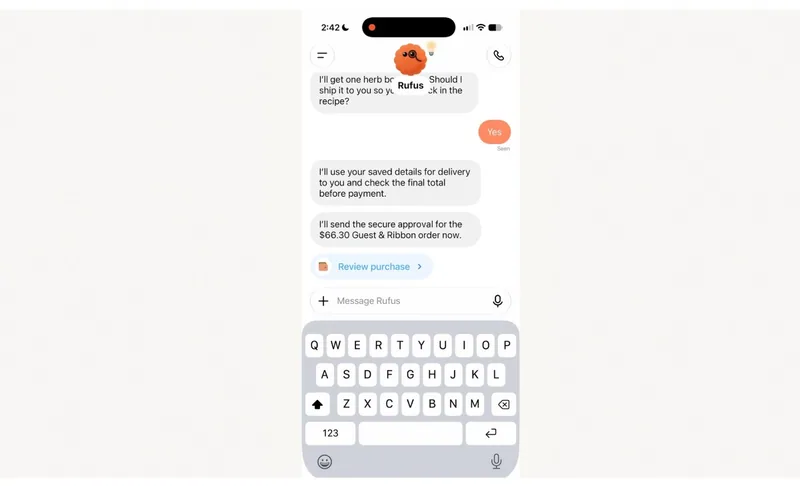
Launched Friday: a wallet feature that lets OpenAI's agents, called dots, help a user decide what to buy and then complete the purchase on their behalf.
Rollout is deliberately narrow — a limited number of U.S. ChatGPT Pro subscribers, ages 18 and up, with a U.S.-issued Visa, Mastercard or American Express.
OpenAI says users stay in control: they review the items, the total and the payment card before checkout occurs, and approve directly with a security check like Face ID or a fingerprint, which TechCrunch notes 'creates a record of their transaction.'
Why it matters for an independent practice: Two applications for a practice. On the marketing side, agentic checkout means the buyer may never land on your page — if you sell anything cash-pay (memberships, supplements, visit packages), your pricing and availability need to be machine-readable or an agent will transact with whoever's is. On the stewardship side, note the shape OpenAI chose: an agent may act, but a human biometric approval generates the audit record. That is the same control you should demand before letting any agent touch scheduling, refunds or ordering in your practice.
Claude Sheets rolled out Nov 10 on paid plans — and there's already a free 7-step build for a shared campaign tracker
The Rundown University · November 12, 2026Buildable AI
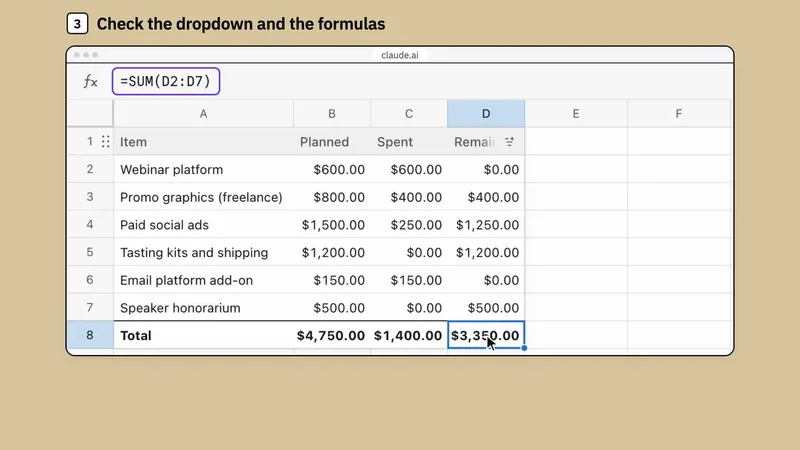
Free beginner guide, 7 steps: build a campaign tracker in Claude Sheets with two tabs (Tasks and Budget), owners, due dates, a Status dropdown (Not started / In progress / Done) and budget formulas you verify yourself, then share it so a teammate can edit.
Availability specifics worth knowing before you go looking for it: as of November 2026 Sheets is a beta on paid plans only — Pro, Max, Ultra, Team and Enterprise — and began rolling out on 10 November, so the green Sheets tile on the Artifacts page may not have reached your account yet. On Enterprise an Owner must switch it on in Organization settings > Artifacts. Mobile is read-only.
The guide publishes its own run log rather than a claim: on 12 November 2026 the build took under a minute and the notice read 'Claude updated 77 cells on several sheets.' Screenshots are dated and taken from an Ultra-plan recording.
The prompt is given verbatim — it names every column, the dropdown's values and which cells are formulas, which is the actual lesson: specificity in one pass beats three rounds of fixes.
Why it matters for an independent practice: This is a 20-minute build that replaces the spreadsheet nobody maintains: a shared marketing-campaign tracker with owners, due dates and budget-vs-spent, live for the whole team. Use it for content calendars, referral-outreach pushes and ad-spend tracking — and keep it strictly non-clinical: a Claude artifact shared by link is not a place for patient data, PHI or anything your BAA would need to cover.
Shared EHR logins break HIPAA's unique-user-identification standard — and inflate what you have to report after a breach
Medical Economics · November 11, 2026Regenerative medicine
By Scott Carr, fact-checked by Todd Shryock and Kirsty Mackay. The core argument: credential stuffing exploits password reuse across unrelated services, so a practice's EHR exposure is set by the weakest outside site where a staff member reused the same password.
Shared accounts defeat auditability — you cannot attribute chart access or actions to an individual workforce member — which the piece ties directly to HIPAA's unique user identification standard at 45 CFR 164.312.
The expensive consequence is downstream: in breach response, being unable to separate attacker activity from routine use inflates presumed exposure and can expand notification obligations, because low-probability-of-compromise determinations under 45 CFR 164.402 become harder to make.
Why it matters for an independent practice: Not an AI story, but it is the precondition for every AI story in this digest. Ambient scribes, agents and automations all act inside the EHR under somebody's credentials — if three people share one login, there is no way to prove whether the human or the tool made an edit, and no defensible attribution when a board or an auditor asks. Unique logins per person, before the pilot, not after.