An 11-location independent practice pulled $250,000 in recovered revenue out of AI — and it came from the billing side, not the scribe
August 17, 2026 · 8 items
ChatGPT was asked ~4,950 times to recommend a doctor. It cited zero of the 200 independent practices tested.
Medical Economics · Todd Shryock · August 13, 2026Patient acquisition
AI has passed the referral. rater8's 2026 Patient Choice Report (992 U.S. adults, fielded April — third straight annual survey) found that among patients who searched for a new doctor in the past year, AI tools were a top influence for 36% — ahead of Google search results (34%) and ahead of a doctor's referral (32%). Among patients who actually switched providers, AI climbed to 39%, edging out every other source tracked. Asked which part of a Google results page they trust most, 37% picked the AI Overview — versus 13% for the local map pack, and five times the number who trust paid ads.
And the shortlist is not neutral. A July Medical Economics study pulled 200 independent practices at random from the national provider registry and ran roughly 4,950 patient-style queries through ChatGPT. The chatbot cited none of them. "Zero still surprised us," said author Nathan Woo. The largest single citation source was hospital staff rosters at 27.5% — pages an independent practice has no equivalent of, since employed physicians land on them automatically. Practice-owned sites were 23%, concentrated among large content-rich groups. Independent visibility ran from ~7% of citations in Boston to >20% in Charlotte; dermatology and plastic surgery leave more room than cardiology and orthopedics.
A 4.0-star rating is now a hard filter, not a nudge. 75% of patients refuse to book below 4.0 stars and 44% won't go below 4.5; only 11% say rating doesn't factor at all. Healthcare's bar is measurably higher than every other industry — BrightLocal's 2026 survey put the all-business figures at 68% and 31%. The deal-breakers behind bad ratings aren't clinical: rude or unhelpful staff and "the doctor didn't listen" tie at 52%, ahead of long waits (41%) and billing (40%).
The biggest year-over-year move is something that costs nothing. Patients saying a provider's response to a review builds their trust jumped from 42% in 2025 to 66% in 2026 — a 24-point swing, the largest of any metric across three years. Meanwhile 68% said they'd leave a review if their doctor simply asked, and the share who "rarely or never" review fell from 56% to 42%. Caution flag: of the 465 patients who used AI to research a provider, 66% hit incorrect information — wrong address, phone, insurance — and 60% trusted the summary anyway. A 2024 BMC Health Services Research study of 449,000+ physicians found insurer-directory addresses were consistent only 17–28% of the time.
Why it matters for an independent practice: this is the clearest evidence yet that the independence problem is now a visibility problem. A regen practice can be the best in its market and still be structurally invisible to the tool 36% of new patients consult first — not because of ranking, but because it has no hospital roster page feeding the model. That makes three MMR moves concrete this week: (1) audit what ChatGPT, Gemini and AI Overviews actually say about each client by name and fix every wrong address, phone and insurance line at the source, because the model inherits dirty directory data and patients don't check it; (2) treat review responses as a first-class deliverable — it's the single highest-moving trust signal in the survey, it's free, and AI systems ingest those public responses when they summarize the practice; (3) stop assuming referrals carry the practice, and start asking — 68% will leave a review if asked, and 15–20 recent five-star reviews is the credibility floor.
An 11-location independent practice pulled $250,000 in recovered revenue out of AI — and it came from the billing side, not the scribe
Healthcare IT News · Bill Siwicki · August 17, 2026Regenerative medicine
Oxford Physical Therapy replaced a homegrown EHR/billing system with the Athelas platform across its 11 locations in February 2026 — and reports more than $250,000 in recovered revenue, a 0.5% end denial rate, faster claims submission, and fewer prior-authorization denials.
Partner and physical therapist Matt Ernst named the sequencing as the reason it worked: they rolled out AI scribing and RCM first, and only then moved to the full practice-management platform. "We have been through EHR changes several times before, but the pre-planning here made a huge difference."
Ernst is blunt about which metric mattered: "The recovered revenue is the most significant, as that is cash in the door. As a smaller company, that definitely is noticeable and impactful." He credits claims visibility plus stronger AI-scribe documentation — "one denial can be leveraged to avoid future ones."
Two second-order effects he didn't buy the software for: the practice held its 4.9-star Google rating while documentation moved into the background, and three former student interns came back asking for jobs after experiencing the AI-assisted workflow — the tech became a recruiting asset.
Why it matters for an independent practice: This is the closest analogue this feed has surfaced to an MMR client: a small multi-site independent practice, not a health system, with a named partner and an audited number. The transferable lesson is the order of operations — money-in first (scribe + RCM), platform second. And note the marketing tie: the 4.9-star rating held because clinicians stopped typing during visits, which means documentation AI is a reputation lever, not just an ops one. That's a proposal slide.
Cleveland Clinic published the ambient-AI rollout playbook in Nature — 3.5 million encounters, and the differentiator was a 2-minute support reply, not the model
Healthcare IT News · Andrea Fox · August 17, 2026Practice operations
Cleveland Clinic Foundation (23 hospitals, 276 outpatient locations, ~80,000 caregivers) reached 4,000 ambulatory clinicians in four months with an ambient AI scribe; at 12 months more than 4,800 clinicians had used it across more than 3.5 million encounters. Rollout began March 10, 2025; the report was published this month in Nature.
They deliberately measured encounter-level utilization — did the clinician use it during eligible visits — rather than adoption. The authors are explicit about why: adoption "captures only whether a clinician has ever used the tool," while utilization "is a foundational metric directly tied to realizing value at scale."
The mechanics that moved the number were unglamorous and copyable: a Project Operating Council running daily coordination, live virtual trainings three times a day, 24/7 live mobile chat staffed by humans, and rapid feedback loops that fielded more than 900 inquiries at an average two-minute response time. Department chairs got dedicated dashboards on their own department's onboarding progress.
The retention payoff: 60% of users agree or strongly agree the ambient AI tool increased their likelihood to remain in practice — against an AMN Healthcare projection, cited in the same piece, of a physician shortage of up to 86,000 by 2036.
Why it matters for an independent practice: This is peer-reviewed evidence for something we keep asserting on instinct: the vendor is not the variable, the implementation is. Every mechanism listed here scales down to a 12-person clinic — three short live sessions instead of one recorded video, a real human reachable in two minutes for the first month, and one named person tracking who has actually used it during visits rather than who has logged in once. When a client says "we bought the scribe and nobody uses it," this is the diagnosis and the prescription, with a Nature citation behind it.
athenahealth just made ambient AI a free, built-in feature for 170,000+ clinicians — no separate scribe license
HIT Consultant · Jasmine Pennic · August 13, 2026Practice operations
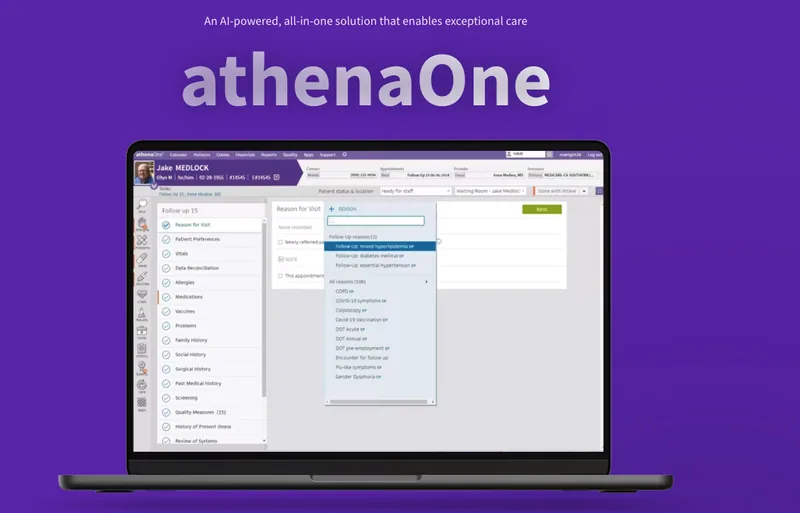
General availability, not a pilot. athenahealth announced broad deployment of AI-native capabilities across the athenaOne network, extending native ambient documentation, decision support and workflow automation to more than 170,000 physicians and clinicians. The core piece, athenaAmbient, captures the patient–clinician conversation on desktop and mobile and drafts the note, infers potential diagnoses, recommends order types and flags care gaps in real time.
It's included in the subscription at no additional cost. HIT Consultant frames this explicitly as a challenge to "traditional point-solution scribes that require external add-ons, separate logins, or per-user monthly licensing fees." That is the whole story for a small practice — the per-seat scribe fee was the reason most independents sat out ambient AI.
The numbers since late 2025: nearly six minutes saved per patient encounter on chart prep and documentation, which athenahealth totals to more than two full workdays recovered per clinician per month. Early adopters report up to 30% higher same-day chart completion.
Built with clinicians, and more is in alpha. Development runs through the EHR AI CoLab inside athenaInstitute — thousands of alpha/beta clinicians across 70+ user groups. In testing now: problem-based summaries, a timeline chart view, an AI-native clinical inbox, and a value-based-care analytics assistant. The quoted customer is not a health system — it's Dr. Lynn Joffe, owner of DTC Family Medicine in Colorado: "I'm able to walk into the exam room with the right context, stay engaged with the patient in front of me, and complete more of my charts the same day."
Why it matters for an independent practice: every ambient-AI story this feed has carried for two months has been an Epic story at a health system — Advocate, ECU, Mount Sinai, Sentara. This is the first one aimed squarely at the ambulatory, independently-owned practice, and the pricing model is the point: the leverage arrives inside software the practice already pays for, with no vendor to evaluate and no new line item. Two immediate uses — for clients already on athenaOne, this is a "turn it on this week" conversation, not a purchase; and for everyone else it resets the negotiation, because "the EHR now includes this for free" is the benchmark any standalone scribe vendor has to beat. Six minutes an encounter is also the most credible number in the category — it's network-wide, not a pilot cohort.
AI video stopped being a creator toy in about seven months — businesses went from under 25% of Higgsfield's revenue in January to the majority now
TechCrunch / PR Newswire · Aug 17, 2026 · August 17, 2026Patient acquisition
Higgsfield raised a $400M Series B at a $5.4B valuation on Aug 17 — up from $1.3B at Series A, a 4x jump in eight months. Led by DST Global with Goldman Sachs Alternatives, Intel Capital, Liberty Global and others.
Annualized revenue hit $700 million this month, from roughly $20 million a year ago. The platform reports 30M+ users across 238 countries and territories, US largest.
The number that actually matters isn't the valuation — it's the mix shift. Founder Alex Mashrabov (ex-Snap) told the Financial Times that enterprise customers now account for the majority of revenue, up from less than 25% in January. The buyer changed from a teenager making filters to a marketing department making ad creative.
Why it matters for an independent practice: Zero medicine in this story, and that's the point. What happened in seven months is that generated video crossed from novelty into the normal cost line of a marketing budget — which means within the next planning cycle a regen-med or aesthetics practice down the street from your client will be shipping ten patient-education and testimonial-style videos a month for what one shoot used to cost. Two implications for MMR: production volume stops being the differentiator, so the physician's actual face, voice and clinical judgment become the moat (P2 — a synthetic explainer of PRP is now commodity; Dr. So-and-so explaining why he declined to offer it to a patient is not). And practically, this is the moment to decide the house rule on disclosure before a client's competitor sets the norm for them.
One AI agent is now taking 624,000 patient calls a year — and another is being pushed to 1 million patients by December
HealthTech Magazine · Erika Gimbel · August 12, 2026Practice operations
MUSC Health's "Emily" handles 624,000 calls annually. Chief Digital Transformation Officer Crystal Broj built it for an operational reason, not a strategic one: "Our call center was open for patient access from 9 to 5, but we wanted 24-hour support. We had patient frustration, workforce pressure and, really, we just wanted to modernize." Emily answers in natural language, handles the majority of nonmedical requests — scheduling, routing to the right department, billing questions, bill payment, pharmacy refill questions — and is integrated with Epic, so a changed appointment updates the record automatically even when the patient isn't logged in. MUSC tested it for over a year before go-live.
Hartford HealthCare is scaling PatientGPT to more than 1 million adults across Connecticut by the end of 2026. Built with K Health, running on Google Cloud, it reads the patient's own record inside Epic once they authorize it. Dr. Padmanabhan Premkumar, president of Hartford HealthCare Medical Group, names the exact gap it fills: "When patients leave a phone message or portal inquiry, that waiting period creates an information vacuum, and many turn to open search engines for immediate answers."
The safety architecture is the interesting part. Every PatientGPT conversation can be shared with the care team, and a second AI agent sits on top of the first to review conversation quality and safety and confirm it escalated to the right place or routed to a clinician. Premkumar's example: a routine medication question where the assistant asks follow-ups, surfaces symptoms the patient didn't realize were critical, and escalates. "That is what sets this apart."
Why closed systems at all: a March 2026 KFF poll found nearly a third of adults have typed their symptoms into a general generative-AI platform. Duke School of Medicine researchers note those chatbots hallucinate partly because the models are trained to please users. Deloitte's Dr. Bill Fera adds the operational upside: "If there is a change in the pattern of visits or complaints, they can better ramp up or ramp down specific services." PwC's 2025 consumer survey found willingness at 45% for an AI assistant giving health updates and triage, and 46% for AI-assisted diagnosis.
Why it matters for an independent practice: strip out the health-system scale and both of these are the front desk. The information vacuum Premkumar describes is exactly what happens at a regen practice between "I filled out your form" and "someone will call you back" — and the patient fills it with ChatGPT, which per item 1 will not name that practice. A voice or messaging agent that covers hours, scheduling, "what does PRP cost," and where-am-I-in-the-process is the highest-leverage automation a single-location practice can run, and MUSC's build gives the honest scope: nonclinical only, EHR-integrated, and tested for a year. The doubled-agent safety pattern is worth stealing wholesale — a second model reviewing the first's transcripts for escalation failures is the cheapest version of the post-deployment auditing the CHAIRS item flagged on Friday, and it's the thing that makes this defensible rather than reckless.
ChatGPT is getting a memory of your whole workday — which files you touched, who you messaged — and it logs "events," not screenshots
The Verge, via TechStartups · Aug 17, 2026 · August 17, 2026Buildable AI
OpenAI is building a feature called Computer History that lets ChatGPT recall activity on your computer. In a demo, OpenAI developer-experience team member Dominik Kundel had it find the last document he edited, check whether he'd shared it in Slack, and summarize his morning.
The design choice is the story: unlike Microsoft's Recall, OpenAI says Computer History does not continuously capture screenshots, video or audio — it records structured activity described as "events." Less raw surface area, but a far more queryable index of who did what, when.
The Verge frames the exposure plainly: the same context that makes an assistant useful becomes a liability if an attacker, a malicious browser extension, or a compromised agent reaches the historical record. The hard part isn't giving the assistant memory — it's collection, retention, permission and deletion boundaries.
Why it matters for an independent practice: Nothing medical here, so extrapolate: this is an activity log of "which files you touched and who you communicated with," and in a clinic those files are charts and those messages are about patients. An assistant like this on a front-desk or biller's machine is a PHI-adjacent audit trail sitting outside the EHR's access controls and outside the BAA — a HIPAA question that arrives as a consumer app update, not as a procurement decision, which is exactly how practices get caught. The leverage side is real too: a practice manager who can ask "what did we not finish yesterday" is running a genuinely tighter operation. Concrete move this week: decide now whether personal AI assistants are permitted on machines that touch patient data, and write it down — before somebody enables it themselves.
Anthropic explained how Claude's watermark actually works — it's not hidden characters, and a real rewrite erases it
Search Engine Journal · Roger Montti · August 15, 2026Buildable AI
It is not what the AI-detection crowd is selling. No Unicode characters, no metadata, no hidden tokens, nothing you can copy-paste out. It is not looking at em dashes or "it's not this, it's that" phrasing, and it is not estimating the likelihood that a human wrote something. In Anthropic's words, the watermark changes only where the randomness comes from when Claude picks the next word: "the words that Claude picks are still random, but now, one can check the sequence of words and see if it's consistent with the choices Claude would make if it was using the key."
It's a version of Google DeepMind's SynthID-Text (2024 Nature paper), which traces back to a 2022 Scott Aaronson proposal. Montti's caveat is the useful one: SynthID is two years old and zero-bit — watermark or no watermark. A 2026 successor, MirrorMark, spreads a multi-bit watermark across the text using surrounding words as context, making it far more edit-resistant. He's explicit that he isn't claiming Anthropic uses MirrorMark — only that "before you put all your eggs into the SynthID basket," know what the current state of the art can do.
How it fails, per Anthropic itself: "Light editing probably won't remove the watermark completely; a complete rewrite where every word is replaced will." Detection performs poorly on small samples and is weaker in factual content, where word choice is constrained. It's weakest of all in proofreading — ask Claude to fix only grammar and punctuation and "the watermark can only live in the handful of corrections, which might be too few to register."
And the detector still isn't public. Anthropic says it plans to release a watermark detection API. Non-text files (JPG, PNG, SVG) get C2PA metadata instead. Watermarking has trivial speed impact and adds no token cost, and Anthropic says it doesn't bias Claude's word choices or degrade quality.
Why it matters for an independent practice: zero medical content here, and it lands directly on physician-authored content — the thing this whole feed says is the practice's real asset. Three practical reads. First, the panic version of this ("AI detectors will flag our blog") is wrong — it's not a style detector, it can't be defeated by removing em dashes, and it can't be triggered by a human who writes like a model. Second, the honest read cuts the other way too: a lightly-edited AI draft published under a physician's name stays marked, and once a detection API ships, a competitor, a journal, or a board could check. The defensible workflow is the one we already recommend — the physician's actual thinking, dictated or interviewed, with AI as the editor rather than the author. Third, and most immediately useful: the watermark is weakest exactly where content is most factual and most heavily edited, which means it is a terrible basis for anyone's compliance policy — including a hospital or health system that decides to start scanning submitted content. Don't let a client adopt a policy built on a detector that hasn't shipped.