Your robots.txt does not stop ChatGPT — OpenAI's own documentation says so, and its bot reached blocked pages on nearly half the sites that explicitly listed it
August 15, 2026 · 9 items
Somebody finally published the scoreboard: here is exactly what share of AI answers each Medicare Advantage brand owns — and it is not the biggest ad budget
Healthcare Finance News · Susan Morse · August 14, 2026Patient acquisition
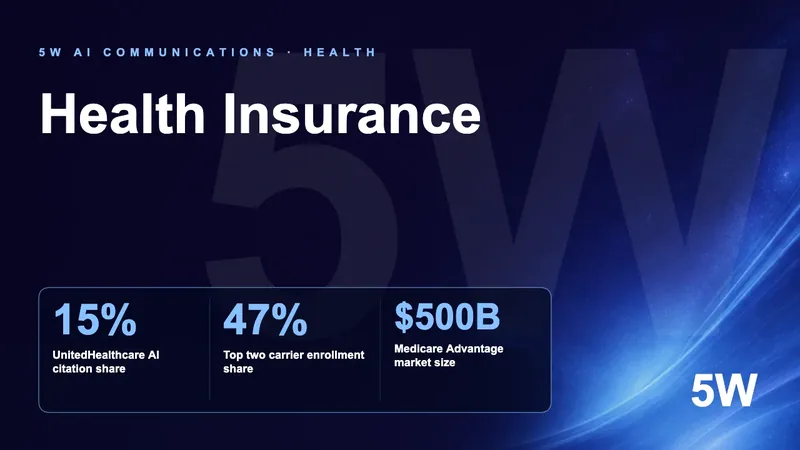
5WPR ran 60+ queries across five AI platforms — ChatGPT, Claude, Perplexity, Gemini and Google AI — and measured each insurer's citation share: how often the brand gets named when a consumer asks about health insurance. 25 MA plans ranked. The insurers did not pay for it and 5W represents none of them.
The board: UnitedHealthcare 15% · Humana 12% · Kaiser Permanente 9% · Aetna 7.5% · BCBS 6.5% · Cigna 5% · Elevance 4% · Centene/Wellcare 3% — then it falls off a cliff: Devoted 2.2%, Clover 1.8%, Alignment 1.5%, Oscar 1.3%, Molina 1.2%, SCAN 1%, HCSC 0.9%.
Kaiser is the tell. Third place with the smallest geographic footprint of the top three — the engines pulled it up out of consumer-satisfaction coverage. Visibility came from what third parties wrote, not from spend.
5W's Ronn Torossian: "up to 50% of searches are now taking place in various search engines," seniors ask ChatGPT before they ask a broker, and the channels these brands actually built on — brokers, direct mail, TV — are invisible to an AI engine. Their fix is boring and doable: keep the site and the public filings accurate and current, because AI front-loads cost and benefit details.
Why it matters for an independent practice: this is the first public, numbered proof of the thing MMR has been arguing — and the methodology is copyable at practice scale. Run 30–60 real patient questions ("best regenerative medicine doctor in [city]", "who does PRP for knees near me", "is stem cell therapy for knees legit") across the same five engines, count how often the client is named versus each competitor, and you have a baseline citation share and a quarterly number to move. Kaiser's result is the strategy: an independent practice out-cites bigger competitors by being the one with accurate, current, third-party-corroborated information — not the one buying the most ads.
Your robots.txt does not stop ChatGPT — OpenAI's own documentation says so, and its bot reached blocked pages on nearly half the sites that explicitly listed it
Search Engine Journal · Matt G. Southern · August 14, 2026Patient acquisition
TollBit's State of the Bots report for the first half of 2026: roughly 15% of identified AI page-fetchers reached URLs the site had marked disallowed. It concentrates in a few agents — ChatGPT-User, Bytespider and Youbot each accessed disallowed pages on nearly half the European sites that had explicitly listed them, and ChatGPT-User reached the most sites of any of them.
OpenAI's crawler documentation states that ChatGPT-User visits a page when a ChatGPT user asks a question, and that because those actions are initiated by a user, robots.txt rules may not apply. Perplexity says the same of Perplexity-User. Anthropic takes the opposite position and states all three of its bots respect the file. TollBit counts any request to a disallowed URL as a bypass regardless of what the operator claims.
The distinction that actually costs money: per OpenAI's docs, the agent that decides whether your site appears in ChatGPT search results is OAI-SearchBot — not ChatGPT-User. SEJ's read: sites that blocked both "traded away the visibility half of that deal and kept a fetching control that carries a carve-out."
Blocking is moving to the network layer, where compliance isn't left to the crawler. Starting September 15, new domains added to Cloudflare have Training and Agent crawlers blocked by default on pages with ads; Search crawlers stay allowed.
Why it matters for an independent practice: two concrete jobs for any practice site this week. (1) Find out whether the site — or the host, or a security plugin someone installed two years ago — is blocking OAI-SearchBot. That one line decides whether the practice can be named in ChatGPT search at all, which is the exact opposite of what yesterday's citation-share scoreboard says you want. (2) Stop treating robots.txt as evidence. The line to keep is SEJ's: server logs or CDN records show what actually arrived; the file only shows what you asked for. And if a client sits behind Cloudflare, Sept 15 is a calendar item, not a footnote — the default is about to change underneath them.
A risk score built inside Epic cut hospital-onset MRSA bloodstream infections 45% — and the team says the algorithm was the easy part
Healthcare IT News · Bill Siwicki · August 14, 2026Practice operations
Sentara Health (Virginia) built a predictive MRSA risk score directly in Epic using data the EHR already held: recent readmission, ICU admission or transfer, prior MRSA history, previous skin infections, diabetes, renal dialysis, plus social determinants like admission from a skilled nursing facility, homelessness or incarceration.
A score of 6 or higher triggers a defined prophylaxis protocol — daily chlorhexidine gluconate treatments and povidone iodine nasal swabs. Certain populations were deliberately excluded.
Result: hospital-onset MRSA bacteremia fell from 53 cases in 2022 to 29 in 2023 — about a 45% decline — with the standardized infection ratio improving too. Sentara estimates $120,000–$384,000/yr in avoided cost, with longer-term projections approaching $2M if sustained.
The design lesson is the real story: they refused to add another interruptive alert. The risk score was embedded into admission workflows, patient lists, nursing reports, flowsheets, HAI huddle reports and Nurse Brain tasks clinicians already used. Documentation moved into flowsheets so patient care techs could participate. Jill Marciano's takeaway — technology alone doesn't improve outcomes; nursing engagement, workflow adoption, leadership accountability and continuous monitoring mattered as much as the model.
Why it matters for an independent practice: this is the cleanest counter-example to "AI pilot fatigue" we've had in weeks, and it scales down. The pattern — take variables your system already stores, score risk, define one concrete protocol the score triggers, and bury it inside a screen staff already open — is exactly how a regen practice would flag a patient at risk of a poor PRP/BMAC outcome, or a no-show, or a lapsed follow-up. Note also what makes this defensible: a before/after count, a dollar range, and a named protocol. That's what an evidence-based claim looks like, and it's the standard to hold vendors to.
Two tools shipped the same day that finally show what AI engines say about you and what they took from your site — plus the reason neither number belongs in a client report yet
The Agile Brand Guide · Aug 13, 2026 · August 13, 2026Patient acquisition
Mod Op launched geo.modop.ai — a free AI Search Visibility Audit scoring how a brand is represented across ChatGPT, Claude, Perplexity and other answer engines. It returns an AI Visibility Score (how prominently you appear), Citation Intelligence (which websites the AI systems actually lean on when discussing you), a GEO Score, and a prioritized optimization roadmap. Alongside it Mod Op published The GEO 50, a benchmark of 50 top brands — and reported that well-known brands do not automatically hold a strong presence in AI answers.
The same day, OtterlyAI shipped Agent Analytics — it reads your server log data and reports which AI agents hit which pages, naming ChatGPT-User, Claude-Bot, Perplexity-User and Google-Agent. Their argument is the important part: standard web analytics is JavaScript-based, and AI agents request pages directly from the server, so this traffic never appears in your dashboard. 40,000+ marketing professionals on the platform as of August.
The two numbers answer different questions and can move in opposite directions without contradicting each other: Mod Op measures what an engine says about you; OtterlyAI measures what an engine took from you. Neither tells you which prompts produced which outcome.
The caveat, stated plainly by the analysis: Mod Op's GEO Score comes from a proprietary framework, and server-log user-agent strings are self-declared and can be spoofed. The IAB published measurement guidelines on Aug 3 warning that AI-visibility vendors apply different methodologies to the same brand, and nothing in these releases resolves that. The trap in the same batch: DeepLumen's "up to 659% AI crawler growth" — a crawler requests pages whether or not a consumer ever asked about the category.
Why it matters for an independent practice: zero medical content, and the application is immediate. This is how MMR builds a client-facing AI-visibility report that survives a doctor asking "what does that number mean?" Run the free Mod Op audit on a client site today for a baseline; pull the server log to see whether ChatGPT-User has ever actually fetched their pages — the same log item 1 says is the only honest record. Then hold the line this piece draws: AI-visibility scores are diagnostic, not reported. They belong in "here's what we're working on," never in the ROI column, until an outside body validates the methodology. Selling AEO is easy right now; selling AEO you can defend in a finance review is the differentiator.
96% of organizations check the AI's note instead of what the AI actually said — a new council just put numbers on the blind spot
Healthcare IT News · Bill Siwicki · August 13, 2026Practice operations
The Council for Healthcare AI Responsibility and Safety (CHAIRS) launched with one focus: what happens after go-live. Convened by Waleed Mohsen (cofounder/CEO, Verbal AI Technologies, which serves as secretariat); members are healthcare quality, compliance and safety leaders. His framing: "Healthcare puts nearly all of its AI oversight into the moment before deployment, then stops watching at the moment the risk actually starts."
The inaugural report, "The Adherence Gap," surveyed 30 healthcare organizations — hospitals, payers and telemedicine companies. Roughly 70% audit patient visits monthly or less. 18% have no formal QA program for virtual visits at all. 96% rely primarily on clinician notes rather than reviewing the underlying interaction. Research found no organization manually reviewing more than about 5% of interactions.
Why notes fail as evidence: "A chart note is not a transcript. It is a curated summary, frequently templated, written by the party being evaluated." With an ambient scribe, reviewing the AI-generated note means using the system's own output to verify its behavior.
Two concrete asks you can act on this week: set escalation thresholds before deployment, and write independent audit rights into the procurement contract. Mohsen's line on vendor metrics: "A vendor's accuracy number comes from the very system being evaluated, so it cannot be the evidence." And the risk shape — a human drifts from protocol occasionally; an AI that mishandles one scenario repeats it identically for every similar patient, and the failures cluster in the uncommon cases.
Why it matters for an independent practice: read this as the missing half of every AI-receptionist and voice-agent build we've been cheering for. If a practice puts an agent on the phone doing intake, triage questions or follow-up calls, this is the question nobody has an answer to: who listens to what it actually said, and how fast would you find out it was wrong? That's a real MMR differentiator — sell the automation and the transcript-level review and escalation thresholds — and it's cheap insurance against the one call that ends up in front of a board.
An AI agent is reading orthopedic referrals before the front desk does — and half the time it routes the patient to a better-fit provider than the referring doctor named
Fierce Healthcare · Cailey Gleeson · August 12, 2026Regenerative medicine
Assort Health launched Referrals, an agent that ingests inbound referrals from EHRs, faxes, PDFs and phone calls, verifies eligibility, and matches the patient to the best-suited provider — then reaches out by voice, text or email and books directly in the EHR.
Co-CEO Jon Wang's numbers: the agent identifies a better-fit provider than the original in 50% of referrals ("this saves providers from seeing the wrong patients, and gets patients seen faster by the right one"). Platform-wide, 79% referral-to-appointment conversion and 87% of referrals fully automated end-to-end.
The named customer is the tell for our world: Center for Sports Medicine & Orthopaedics in Chattanooga. Call Center Manager Jensine Joseph says the referral team was "overwhelmed by the volume" — initial outreach took "three or four business days," follow-ups "sometimes didn't happen for a week or more." Now outreach goes out within hours of receiving the referral, ~90% of referrals automated end-to-end and a 77% conversion rate. Her line: "Patients hear from us before they start looking for other options."
Underneath it is Synapse, Assort's proprietary model built on 225M+ specialty-specific patient interactions and 70,000 care protocols and decision pathways. The company raised a $120M Series C in June at a $1.2B valuation and says it now serves "several hundred customers."
Why it matters for an independent practice: this is the closest read on a regen practice the feed has had in weeks — sports medicine and orthopedics is the referral lane into PRP, BMAC and MFAT. The number to sit with isn't the 90% automation, it's "three or four business days" versus "within hours," because that gap is precisely where a referred patient gives up and goes back to Google — or to ChatGPT, which item 1 says may not even be able to see the practice. And the buildable version doesn't require a $1.2B vendor: a practice with an EHR plus an n8n or GHL workflow can automate inbound-referral acknowledgment and first-touch scheduling this quarter, and that's a concrete MMR deliverable. One condition, from Thursday's CHAIRS item: whoever ships it also has to decide who reviews what the agent actually said on those calls.
Patients keep under 20% of what you tell them — a new ambient AI turns the conversation into a task list for the patient and for the family member who wasn't in the room
HIT Consultant · Fred Pennic · August 14, 2026Practice operations
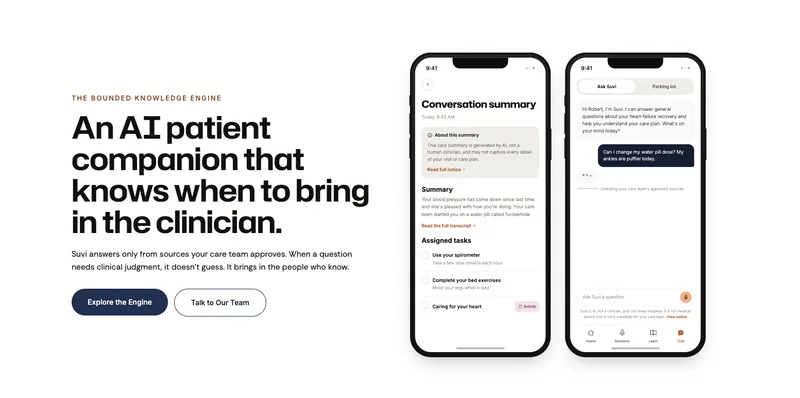
Suvi Health launched its Ambient AI Care Coordination Platform, aimed at the place first-generation ambient AI never went. That first wave was almost entirely outpatient clinical scribing built to ease physician documentation fatigue; this targets the acute inpatient environment, where communication drop-offs between attendings, nurses, specialists and family directly inflate length of stay and drive preventable 30-day readmissions.
The finding underneath the product: research cited in the reporting indicates patients retain less than 20% of the information communicated during hospital rounding. Discharge instructions, medication changes and daily recovery milestones stay locked in fragmented shift notes, and remote family caregivers are left unprepared for the transition home.
How it works: no manual scribe start/stop. Deployed on a patient's phone or a room tablet, it detects when a care team member enters, records the multi-provider exchange — roughly 17 bedside conversations a day for complex cases — and stops when they leave. It then distills doctors, nurses, pharmacists, physical therapists and nutritionists into a prioritized daily task list and a plain-language progress summary, and pulls distant family into real-time visibility on what's actually required (incentive spirometer use, low-sodium restrictions, mobility targets). Light-touch ambient layer, minimal EMR integration, HIPAA compliance and two-party consent built in.
It's a co-development, not a pitch deck: built through a year-long collaboration between University of Notre Dame researchers and Mayo Clinic Florida clinicians under 1842 Studio (1842 Fund / Alloy Partners). A four-month pilot begins at Mayo Clinic Florida in September 2026, targeting chronic heart-failure admissions across cardiology and internal medicine, with length of stay as the outcome it has to move.
Why it matters for an independent practice: the inpatient framing is borrowed clothing — the finding is about every consult room you own. If a hospitalized patient retains under 20% of what's said at the bedside, the patient in a regen consult absorbing "PRP versus BMAC, expected timeline, what recovery actually looks like, what it costs" is not doing better — and the spouse or adult child who drives the decision usually wasn't there at all. The transferable build is small and it's yours: with consent, turn the recorded consult into a plain-language summary plus a dated task list the patient and their family can open. That's three things at once — a better clinical outcome, a conversion tool for the treatment plan that gets discussed and then never booked, and a trust artifact, because it puts what you actually said in writing before anyone can misremember it.
OpenAI's foundation put $100M behind one unglamorous job: using AI to find the patients who already fell out of care
Fierce Healthcare · Cailey Gleeson · August 13, 2026Practice operations
The OpenAI Foundation invested $100 million in the Breakthroughs to Follow-Through (B2F) Initiative with the Common Health Coalition — explicitly aimed at the gap between a treatment existing and a patient actually receiving it.
The stated target is measurable, not vague: "at least double" hepatitis C cure rates over the next two years across eight states and localities. First four named — Alabama, Illinois, Louisiana, Massachusetts; four more announced within six months. Then it expands to HIV prevention and curable cancers.
What the money actually buys: AI-enabled tools to identify patients who have fallen out of care, reduce administrative burden, strengthen care coordination — plus technical assistance, implementation expertise and cross-jurisdiction evaluation.
Alabama State Health Officer Scott Harris, M.D., named the problem plainly: "A cure is available for most people, but we are not always able to reach those who have not yet been diagnosed or connected to care." Coalition chair Dave Chokshi: "Dramatic progress on health is entirely within our reach, but it requires pairing discovery with delivery." The organizations also point to the bipartisan Cure Hepatitis C Act of 2026 as the national frame.
Why it matters for an independent practice: strip out the public-health packaging and this is patient reactivation — the highest-ROI, least-glamorous marketing asset a practice already owns and almost never works. Every regen practice has a list of people who consulted and never booked, finished one PRP round and vanished, or lapsed after a single visit. If a $100M initiative's core AI use case is "find the people who fell out of care and get them back," that's the strongest possible endorsement of the recall/reactivation campaign we can build from a client's existing EMR and CRM data — and it's relationship work, not extraction: reaching people who want the outcome and got lost in the gap.
Meta open-sourced a 30B agent brain that fits on one $2K graphics card and never phones home — Apache 2.0, download it today
Meta AI Research + MarkTechPost · Aug 10, 2026 (5 days — flagged) · August 10, 2026Buildable AI
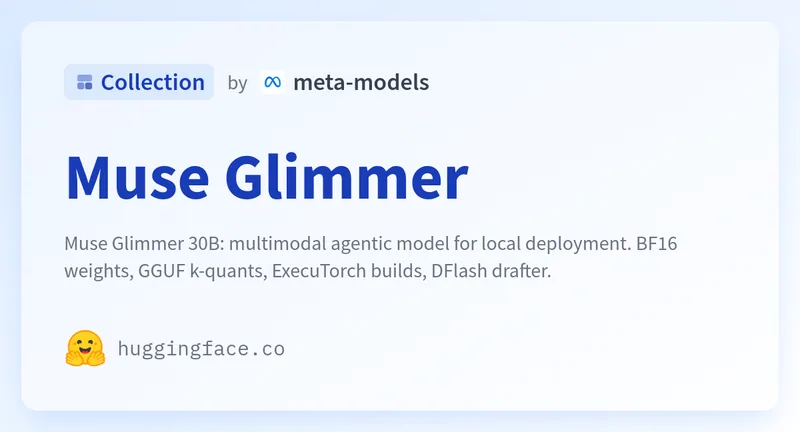
Muse Glimmer: a 30-billion-parameter multimodal model distilled from Muse Spark, released under Apache 2.0 — weights on Hugging Face (BF16, GGUF k-quants, ExecuTorch builds). Meta's own framing: an open agentic model that runs on your device, "with no network call." Meta's first significant open-weight release in over a year.
The engineering that makes it real: 30B needs 55+ GB at full precision. Meta quantizes to ~4-bit — K-Quant-17GB fits a 24 GB card at 1.0% average degradation; the 32 GB dynamic quant costs 0.2%. Then DFlash block speculative decoding (16 tokens per forward pass) takes an RTX 5090 from 74.9 → 233.4 tokens/sec, a 3.1× speedup; M5 Max 26.6 → 50.2. Context 131,072+; knowledge cutoff Jan 4, 2026.
It's tuned for agent work, not chat: tool use, long multi-step tasks, failure recovery, schema-based function calling, desktop agents that read screenshots, document and chart understanding. Beats Gemma4-31B and Qwen3.6-27B on MCP Atlas (75.5 vs 54.2/62.5), DeepSearch QA and SWE-Bench Pro; trails Qwen on OSWorld-Verified and TerminalBench.
The caveat, stated plainly: Siren AgentDojo prompt-injection attack success rate is 28.4. Meta explicitly advises adding system-level guardrails rather than shipping the model as a bare endpoint. Meta also names healthcare first in its list of target industries — the settings where "data residency, offline operation, or latency rule out a cloud call."
Why it matters for an independent practice: this is the "0% medical, extrapolate" item, and the extrapolation is unusually direct. An agent capable enough to run intake summarization, chart-note drafting, document extraction and multi-step follow-up workflows now runs on a single machine sitting in the practice — no per-token bill, no BAA negotiation, no PHI leaving the building. That is independence in the most literal sense: the cheapest answer to "can we use AI without handing our patient data to a vendor" just became a download. Pair it with today's item 3 — Meta is telling you outright that a 28.4 injection rate means guardrails and monitoring are your job, not the model's.