ARPA-H puts up to $38M behind UVM's ICU "digital twin" — treatments tested on a simulated patient before the real one
October 2, 2026 · 5 items
ARPA-H puts up to $38M behind UVM's ICU "digital twin" — treatments tested on a simulated patient before the real one
Healthcare IT News · October 1, 2026Practice operations
The Larner College of Medicine at the University of Vermont gets up to $38 million over five years under ARPA-H's CIRCLE program for the ReSCUED project, targeting severe trauma, burns and sepsis.
Milestone-based and explicitly staged: researchers must develop and validate the twin and show it can predict patient outcomes computationally within the first three years before any clinical trials in critically ill patients.
The data pipeline is aggressive — patient blood collected every six hours at multiple sites to measure cells, proteins and molecules, fed back into the twin so the AI refines its forecast as the patient changes.
UVM cites 4.6 million Americans treated in ICUs annually at up to $70 billion a year, and claims digital twins could shorten ICU stays by as much as 25%. PI Dr. Gary An, a UVM trauma surgeon: "The multidimensional dynamics of immune dysfunction is too complex for a person, even an expert, to comprehend."
Partners include Wake Forest, UAB Heersink, Washington University, and the DNA Medicine Institute, contributing a bedside molecular testing platform originally built for the International Space Station.
Why it matters for an independent practice: This is the shape of credible clinical AI funding to point patients and referrers at: validate computationally, then prove outcomes, then touch patients. When a regen-med practice is asked "is your AI proven?", the honest answer borrows this sequence — and note that the 25% figure is UVM's projection, not a result.
AI care-plan study reports 83.5% of patients improved or held steady — with no control group
Longevity.Technology · October 1, 2026Regenerative medicine
A retrospective study of 345 paired tests of uMETHOD Health's RestoreU found 83.5% of patients improved, held steady or declined slowly — and the article states plainly there was no control group.
The population was genuinely hard: average age 74.6, 9.0 comorbid conditions, 11.7 medications, and per uMETHOD 23 clinically significant drug-drug interactions across those medications.
RestoreU is described as an AI-based clinical decision support service that reads the full record over time — diagnoses, medications, labs, genomics, lifestyle — and outputs a prioritized care plan for clinician, patient and caregiver.
The North Carolina company says it has been commercially deployed since 2016 and runs inside the lab and EMR systems clinics already use.
Why it matters for an independent practice: This is the exact claim shape a longevity or regen-med clinic will be pitched this quarter: a big percentage, a real patient population, and no comparator. Ask for the control arm before the number goes anywhere near your marketing — a retrospective 83.5% with no control is a hypothesis, not evidence, and publishing it as proof is a trust liability.
Meta says its Muse agent can't read Messages without Full Disk Access — after a journalist said it did
TechCrunch · September 30, 2026Buildable AI
Inc. columnist Jason Aten reported that Meta's Muse AI agent read his private messages when he never asked it to; Meta VP of Communications Andy Stone pushed back publicly on X.
Stone's position: "The Messages integration in the Muse app for Mac is entirely opt-in... You have to enable both Full Disk Access and the Messages connector for Muse to be able to read your Messages content."
The dispute is not about capability — both sides agree the agent can read local message content once two permissions are on. The disagreement is over whether the user knowingly turned them on.
Why it matters for an independent practice: Swap "Messages" for anything on a front-desk or physician laptop and this is a BAA question, not a gadget story. Before any desktop AI agent goes on a practice machine, write down who can grant Full Disk Access, what's in reach once granted, and how you'd prove after the fact that consent was given — because that's precisely the point this argument is stuck on.
13,000 phrases now give away AI prose — and Claude models are drifting toward human writing while GPT models drift away
TechCrunch · October 1, 2026Patient acquisition
A new study from the marketing firm Graphite catalogued frontier models' favorite words and phrases, defining a "tell" as a phrase at least twice as common in AI content as human content — and found 13,000 of them.
Opus 5.5's biggest tell is the word "dependable," appearing 23 times more often than in human samples; the model also leans on telling you "this matters."
Early giveaways like em-dashes and "delve" have been stamped out, but models still fall back on contrast-heavy constructions, with each version carrying its own quirks.
Graphite chief AI officer Greg Druck told TechCrunch: "It turns out that Claude models are actually getting closer to the human word distribution over time. And for the GPT models, it's getting further away."
Why it matters for an independent practice: A physician's byline is the asset, and the tells are now numerous enough that readers and patients will spot ghost-written AI content without needing a detector. Treat drafting as drafting: dictate the doctor's actual reasoning and cases into the piece, and run a find-and-kill pass on the model's pet phrases before anything publishes under a provider's name.
Ezekiel Emanuel's conundrum: past some point, human oversight of medical AI may add more errors than it catches
AI and Healthcare · October 1, 2026Practice operations
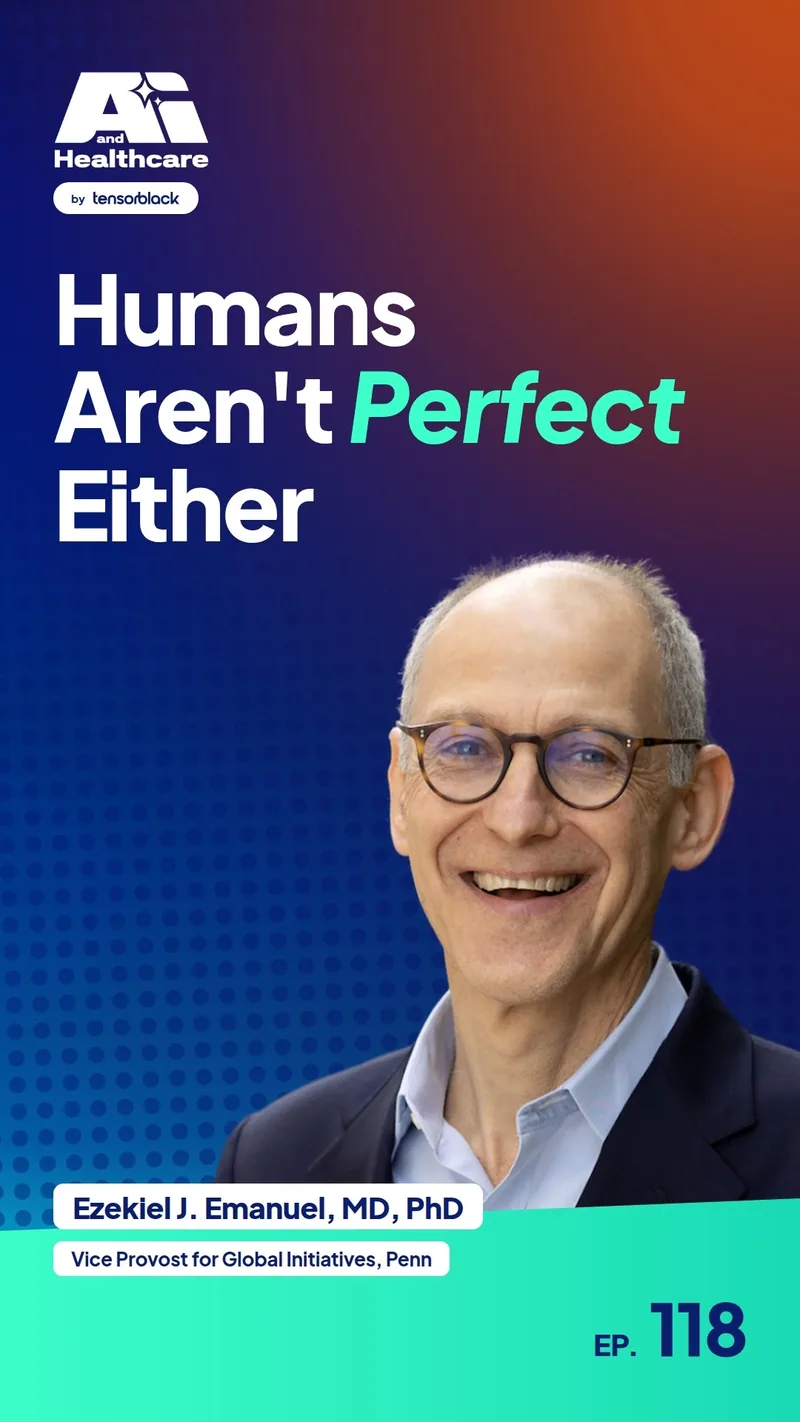
A Short clipped from Episode 118 of the AI and Healthcare podcast with host Sanjay Juneja, MD, featuring Ezekiel J. Emanuel, MD, PhD.
The description frames the argument through Waymo: the cars are not perfect and do have accidents, but are comparatively far safer than human drivers — and Emanuel expects the same of autonomous AI in medicine, consistently better than us and still imperfect.
The stated conundrum, in the description's words: the better the system gets, the worse our intervention looks, until "we will introduce more errors than we will catch on AI."
Short-form clip, so this is the setup for the argument rather than the full case — the supporting reasoning sits in the full episode, not here.
Why it matters for an independent practice: This is the uncomfortable end-state of "human in the loop" and it's worth a physician having a position on it before a patient or a payer asks. For now the practical read is the opposite of hands-off: oversight is still the defensible posture, and the question to track is what evidence would ever justify loosening it.