Healthcare attorney: an AI vendor that keeps your patient data after the contract ends leaves the practice holding the liability
October 7, 2026 · 5 items
Healthcare attorney: an AI vendor that keeps your patient data after the contract ends leaves the practice holding the liability
Medical Economics · October 1, 2026Practice operations
Tatiana Melnik, J.D., a Tampa health care attorney who represents physician practices, led the session "Privacy and Security Legal Issues in the Age of Artificial Intelligence" on Sept. 28 at MGMA's 2026 Annual Conference in San Antonio, then sat down with Medical Economics.
Her framing: once a tool can reach protected health information, HIPAA applies "same as it does to every other technology" — scribes, scheduling and prior-auth tools included.
She flags that de-identification used to be a low-risk concession: "Now, in the age of AI, you might decide it's high risk because re-identification is so easy."
Specific contract language to pin down: what the vendor means by "usage data" (does an AI prompt count?), what counts as "confidential information," whether the vendor may keep data after termination and whether it can actually delete it. Many of these contracts cap vendor liability at 12 months of fees — and the article notes the practice is left holding the liability once that cap runs to zero.
Why it matters for an independent practice: This is the single most useful thing an independent practice can do this week: pull every AI vendor agreement already signed — scribe, intake, phone — and read the usage-data, retention, deletion and liability-cap clauses before adding another tool.
Clinicians argue agentic AI's real payoff is the post-visit backlog, not the note — and that physicians, not vendors, must define the problem
Healthcare IT News · October 1, 2026Practice operations
Dr. Talha Shaikh, chief of radiation oncology at New York Cancer & Blood Specialists/One Oncology, says most AI physicians use today is passive — it summarizes a chart or drafts a note, but the physician still figures out what happens next. "Agentic AI changes that — it can recognize that something is incomplete, take the next few steps, coordinate across different parts of the system and bring the physician back in when a clinical decision is actually needed."
Shaikh's named early use cases are the chase work: missing records, abnormal results needing follow-up, uncompleted referrals, prior authorizations, treatment prerequisites and patient messages.
Joy Xu, UCLA medical student and lead author of the July 2026 npj Digital Medicine paper "AI agents in clinical practice: An evidence map," frames the change as physicians moving from task execution to task oversight — agents perform functions like prior auth autonomously while physicians monitor outcomes.
Xu's warning is the governance line worth stealing: "True workflow transformation requires that problems be defined by physicians experiencing the burden, not by vendors offering systems." Dr. Nipa R. Shah (University of Florida College of Medicine at Jacksonville) adds that EHR integration and patient acceptance shape what can actually be deployed.
Why it matters for an independent practice: For a regen-med or independent practice, this reframes the AI buying question away from "which scribe?" toward "which unfinished task after the visit costs us the most?" — and the evidence map gives a named, citable paper to point at when a vendor pitches the other direction.
Amazon blocked Meta's Muse agent from its retail site, and a new standard is being floated to decide which AI agents get let in
TechCrunch · October 6, 2026Buildable AI
Consumer agents — Meta's Muse, ChatGPT's Dots and others — now book flights, make reservations and order groceries without the user setting anything up themselves, per reporter Sarah Perez.
The friction is on the other end: Amazon began blocking Meta's Muse from its retail site, so the agent can no longer browse or purchase from its catalog. TechCrunch reports user complaints across social media show agents hitting similar blocks elsewhere, some deliberate and some from generic anti-bot defenses.
The article frames consumers as caught in the middle, with a new standard proposed to sort legitimate agents from unwanted bots.
Why it matters for an independent practice: Practice websites and booking pages sit behind the same anti-bot and security stacks — which means the day a patient's agent tries to book an appointment, your site may silently refuse it. Worth asking your web host and scheduling vendor now whether their bot defenses distinguish a patient's assistant from a scraper, because "invisible to agents" will soon cost appointments the way "not mobile-friendly" once did.
OpenAI is putting visual display ads next to ChatGPT image results, starting in the U.S. later this month
TechCrunch · October 5, 2026Patient acquisition
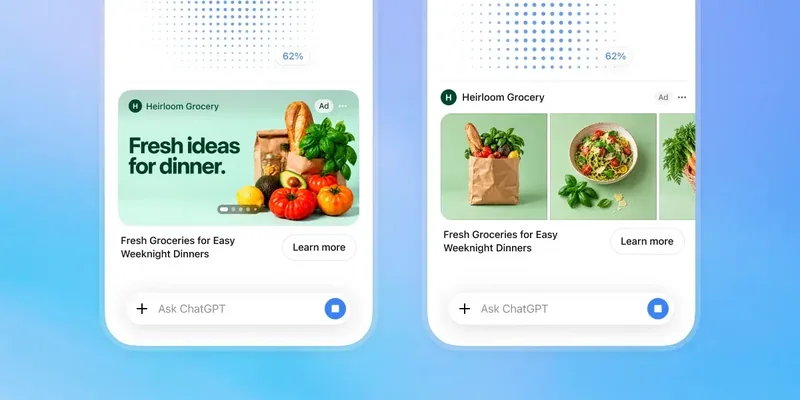
The new format places display ads alongside images users ask ChatGPT to generate; it begins appearing later this month in the U.S. only, with products and services from an initial test group of advertisers.
OpenAI says the ads will be clearly labeled and won't influence the answers ChatGPT provides. The company is also expanding ad measurement tools and partnerships and developing new ways to determine brand suitability.
Context from the piece: OpenAI introduced ads earlier this year to support its free and low-cost tiers and expanded them to India in August; the visual push follows the launch of Meta's Muse, a free agentic AI app competing with leading chatbots.
Why it matters for an independent practice: A second paid surface is opening inside the tool patients increasingly use to compare physicians and service lines — so the MMR question becomes brand suitability and labeling before budget: what would it mean for a regen-med clinic's authority to appear as a labeled ad next to an AI-generated image, and how does that sit against earned citation in the answer itself?
Longevity podcast puts the peptide boom's core problem plainly: demand is outrunning the systems meant to make these compounds safe and accountable
Longevity.Technology · October 5, 2026Regenerative medicine
The latest episode of Longevity.Technology UNLOCKED has host Phil Newman in conversation with Dr Fady Hannah-Shmouni — clinical endocrinologist, biochemical geneticist and founder of Hormonaly AI — and Koehl Robinson, founder and CEO of Celia Group, the company behind Celia RX.
The piece describes the landscape behind the social posts and "research use only" vials as one where demand is moving faster than the systems designed to make these compounds safe, understandable and accountable.
Framing offered for patients and staff: peptides are short chains of amino acids that act as signaling molecules — "closer to biological messages than building materials" — produced by the body in the thousands, with levels shifting over a lifetime.
The stated question of the episode is not whether peptides work, but what has to change when an emerging field becomes too popular to remain loosely regulated — the article points to better evidence and cleaner supply chains.
Why it matters for an independent practice: Peptide-prescribing regen-med clinics are the ones patients will ask about gray-market vials they found online; this is a current, named-expert source to cite when drawing the line between your sourcing and theirs — and a reminder that supply-chain provenance is becoming the trust differentiator, not the marketing copy.