Yelp now dials businesses for users — the voice on your front-desk line is increasingly a bot
October 21, 2026 · 4 items
Yelp now dials businesses for users — the voice on your front-desk line is increasingly a bot
TechCrunch · October 20, 2026Buildable AI
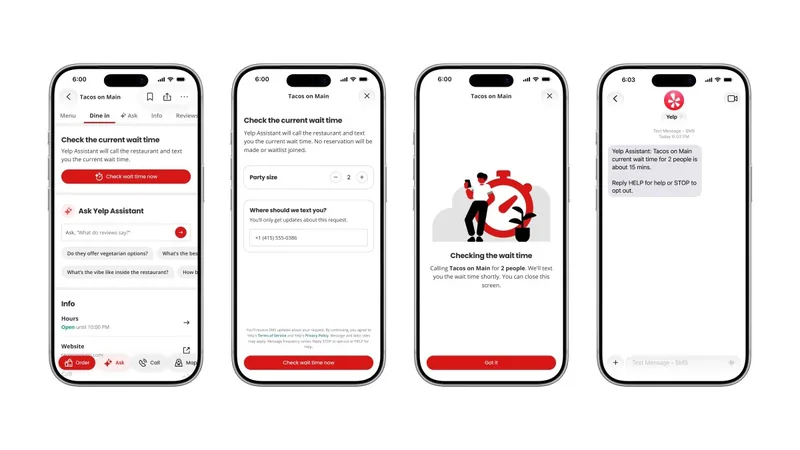
Yelp's new "Check for Me" feature appears on restaurant pages in the app: the user enters party size and phone number, an AI voice agent calls the business to check wait times, and the result is texted back.
TechCrunch frames this as a trend, not a one-off — over the last few weeks personal assistants Instinct, Fo, and Muse have all enabled users to call businesses for customer support and appointment booking.
Yelp is building on both sides of the call: it debuted a voice solution for restaurants and service providers last year, so agent-to-agent calls are the logical end state.
Why it matters for an independent practice: Swap "restaurant" for "regen-med clinic" and this is a staffing question this quarter: your front desk will start fielding calls from software asking about availability, pricing and next-opening — so the phone script, hold policy and after-hours answering need to survive a machine caller. The mirror image is the opportunity: the same voice-agent tech is what you'd deploy to answer and qualify inbound calls instead of losing them to voicemail.
ChatGPT's new locked chats are a screen lock, not a privacy control — OpenAI says so itself
TechCrunch · October 20, 2026Buildable AI
OpenAI announced Tuesday that users can lock individual ChatGPT conversations behind a four-digit PIN, or Face ID / Touch ID on supported devices.
Unlike Temporary Chats, which run in a separate session that never enters chat history, locked chats stay in history and can be returned to at any time.
OpenAI explicitly notes that locking a chat does not create end-to-end encryption or a separate encrypted vault, does not change how long the chat is retained, does not remove anything ChatGPT remembered before the chat was locked, and does not change the "Improve the model" setting.
TechCrunch's framing is the risk: the feature exists because the app is increasingly used for personal conversations.
Why it matters for an independent practice: Expect a staff member to read the headline and conclude it's now safe to paste patient specifics into a personal ChatGPT account. It isn't — a PIN protects the screen, not retention, memory or model training, and none of it is covered by a BAA. This is a one-paragraph addition to your practice's AI-use policy this week: locking is for shoulder-surfing, not for PHI.
US orders federal agencies to rip out DeepSeek — including third-party tools built on it
TechCrunch · October 20, 2026Buildable AI
Per the Department of Homeland Security, federal civilian agencies must stop purchasing DeepSeek products and services and remove them from government IT systems.
The order cites national security concerns tied to the Chinese AI startup's operations in China.
Critically, the directive reaches past the DeepSeek app itself to third-party services built using its technology.
Why it matters for an independent practice: The "built using its technology" clause is the part that lands on a practice. Model provenance just became a procurement question: ask every intake chatbot, scribe, and marketing-content vendor which models sit underneath their product, and get the answer in writing. Federal bans have a way of becoming payer, hospital-partner and state-board expectations within a year — being able to answer the question early is cheap, scrambling later is not.
OpenAI buys Orchestra Bio, pulling the life-sciences ops-agent layer inside the model company
TechCrunch · October 20, 2026Practice operations
OpenAI acquired four-year-old Orchestra Bio on Tuesday; terms undisclosed, though the startup had reportedly raised around $20 million as of 2025 from Andreessen Horowitz, Atria and 8VC.
Orchestra builds AI agents that handle drug-discovery operations minutiae — tracking finances, resolving clinical-trial scheduling issues.
The team and technology go into Rosalind, OpenAI's life-sciences research model, and the Rosalind Workbench tool for planning experiments and analyzing results; OpenAI names Moderna and Novo Nordisk as Rosalind customers.
TechCrunch's read: the big labs keep building software for the biggest industries, and startups live with the fear that a lab ships their feature — here, Orchestra was absorbed rather than stomped out.
Why it matters for an independent practice: This is the independence question in miniature. The niche workflow-agent vendor you'd evaluate for scheduling, trial logistics or practice operations is exactly the layer the foundation-model companies are now buying. Before you sign a multi-year contract with a small AI ops vendor, ask what your exit looks like if OpenAI or Anthropic ships that capability natively — and keep your own data and processes portable enough that the answer isn't "we start over."