Claude designed 211 scorpion-toxin binders, 17 bound to target — and none are proven to neutralize venom
October 23, 2026 · 5 items
Claude designed 211 scorpion-toxin binders, 17 bound to target — and none are proven to neutralize venom
The Rundown AI · October 22, 2026Practice operations
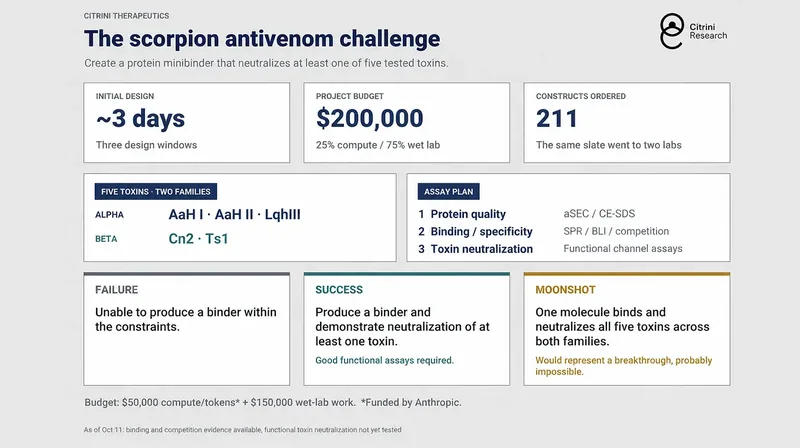
Anthropic published the research on October 20: an internal Claude generated 318,484 candidate designs during a 64-hour run using 12 specialist tools, selected 180 designs, and humans added 31 — the 211 finalists went to Twist Bioscience and Adaptyv Bio for lab testing, yielding 17 qualifying binders against four of five toxin targets.
The people driving it were not drug developers: five staffers from investment research firm Citrini Research, three with no science background, working from a prompt of roughly 35 pages with help from Anthropic staff. Citrini logged five human messages during the initial design run and 367 across the whole project.
The headline caveat is in the source itself — whether the proteins stop the toxins' effects in cells or protect animals remains untested, and Citrini called its universal antivenom experiment a failure.
Cost breakdown is the honest part: ~$200,000 total, of which $49,997 was compute and just under $150,000 was lab charges, with roughly a two-month wait for experimental work. Anthropic released all 211 designs, predicted scores and results publicly under CC BY 4.0.
Why it matters for an independent practice: This is the template for every 'AI discovered a cure' headline your patients will bring to an appointment for the next two years — a genuine technical result wrapped around an unproven therapeutic claim, disclosed clearly by the people who ran it. A physician who can say 'it bound to the toxin in a dish, nobody has shown it protects an animal yet' sounds like the most credible person in the room; one who repeats the press release does not.
Uber took ChatGPT Work from a 1,000-person pilot to all 30,000 employees — and 80% of early adopters were non-engineers
TechCrunch · October 22, 2026Buildable AI
Uber and OpenAI announced the expansion Thursday; the entire global workforce of roughly 30,000 people now gets ChatGPT Work, the enterprise agent OpenAI introduced in July.
The pilot ran earlier this year with 1,000 employees drawn from finance, operations and product — and Sumanth Sukumar, Uber's VP of engineering, told TechCrunch that 80% of early adopters were non-engineers.
The actual pilot use cases were ordinary office work: analyzing operations data to identify trends, localizing training materials for different markets and languages, and building personalized interactive dashboards for daily work.
Uber has not standardized how people use it — 'our approach is to make powerful AI tools available across Uber while giving teams room to experiment,' Sukumar said — and earlier this year it paired 30 AI engineers with teams for two-week automation sprints.
Why it matters for an independent practice: The pilot-then-expand sequence scales down cleanly to a practice: start with your front desk, billing and marketing staff rather than your most technical person, pick three bounded jobs (payer-policy summarization, translating patient education materials, building a weekly dashboard), run it for 60 days, then widen. The 80%-non-engineer number is the argument to make to the office manager who thinks AI is an IT project.
Canva's first image model was trained on design templates instead of photographs — aimed squarely at legible text and editable layouts
TechCrunch · October 22, 2026Buildable AI
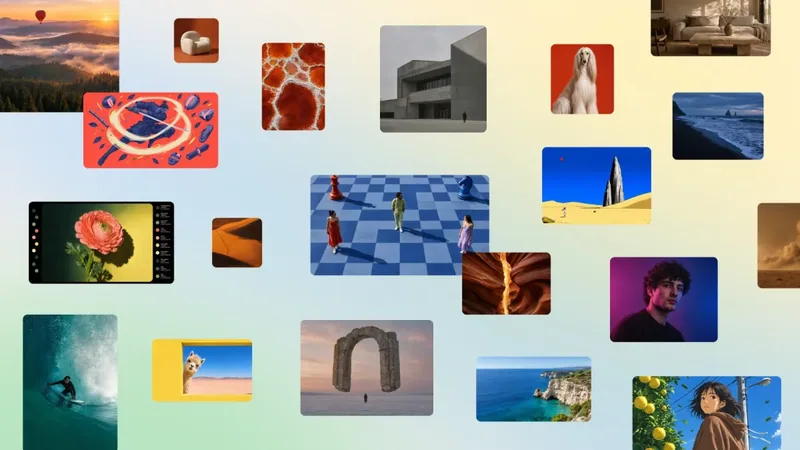
Canva Craft works in two stages: it first interprets the prompt and builds a plan covering spatial relationships, relative scale, visual hierarchy and text details, then generates an image up to 2K resolution in any of 30 aspect ratios.
Rather than photographs, Canva says it trained on human-designed templates from its own library — posters, social posts, presentations, infographics, menus and typography-rich layouts — which it credits for accurate object detail and legible text.
Canva claims users can make precise edits without disturbing other parts of the image, and that Craft output can be converted into layered designs via Canva Magic, its image-to-design transformer.
It is available to all users on the platform, positioned against same-category models from Google, OpenAI, ByteDance and Meta.
Why it matters for an independent practice: Practice marketing lives or dies on text-in-image assets — appointment-reminder graphics, procedure explainers, event flyers, 30 platform sizes of the same announcement — which is exactly where general image models have been worst. A model tuned on layouts rather than photos, with layered output your designer can still correct, is the difference between AI creative you can ship and AI creative you have to redo. Keep the human sign-off: anything with a clinical claim still needs physician review before it goes out under the practice's name.
Walmart opened an Agent Gateway to let AI agents buy on customers' behalf — a month after Amazon started blocking them
TechCrunch · October 21, 2026Buildable AI
Walmart announced the Agent Gateway on Wednesday to manage transactions and other features for customers shopping via AI agents, with controls over spending and transaction approvals.
The move lands shortly after Amazon began blocking AI agents from making purchases on behalf of online shoppers — TechCrunch notes Meta's AI agent was blocked from Amazon.com in September.
TechCrunch frames Walmart as differentiated not only from Amazon but from travel and booking sites that have responded to rising consumer agent use by restricting them.
Why it matters for an independent practice: Two of the largest retailers in the country just made opposite bets on whether to let someone else's software transact with them, and practices face the same fork on a shorter timeline: when a patient's assistant tries to check your availability, read your fees, or request an appointment, does your site answer it or wall it off? The posture to copy is Walmart's — let agents in, but gate what they can commit to, with approval thresholds and a human confirmation step before anything is booked.
Zealand Pharma is paying Generate Biomedicines up to nearly $1.2B to AI-design multispecific proteins for obesity
Longevity.Technology · October 22, 2026Regenerative medicine
The deal was announced on 13 October: a multi-target strategic collaboration and license agreement to design multispecific protein therapeutics for obesity and other metabolic diseases, with nearly $1.2b in milestones.
Two programs start the collaboration, with an option to add a third — and the release does not disclose the targets, which Longevity.Technology flags as the most interesting unanswered question.
Zealand has been a peptide company for more than 25 years; the deal is its move from peptides into larger, more structurally elaborate proteins, with the AI design work handled by Generate Biomedicines.
Why it matters for an independent practice: The metabolic/weight-loss category that drives a large share of regen-med and longevity-clinic revenue is where AI protein design is now being funded at nine figures — meaning the next generation of obesity agents your patients ask about will arrive with 'AI-designed' in the headline. Worth tracking now so your clinic's GLP-1 and metabolic conversations stay ahead of the marketing rather than reacting to it.