A signature on an ambient AI note only proves the physician opened it — Penguin Ai's CMO wants monthly audits against the visit recording
November 20, 2026 · 5 items
A signature on an ambient AI note only proves the physician opened it — Penguin Ai's CMO wants monthly audits against the visit recording
Healthcare IT News · November 19, 2026Practice operations
Dr. Niki Panich, chief medical officer at Penguin Ai, names the failure modes she sees in polished AI-generated notes: "A negation flips, and 'denies chest pain' becomes 'reports chest pain.' A family member's history lands in the patient's. A dose gets misheard. A full physical exam shows up for a visit that happened by phone."
Why they slip past review: "When a tool is right most of the time, review turns into skimming, and skimming turns into a click." She notes most notes get reviewed in a batch at the end of a long clinic day, when attention is lowest.
Her proposed structure: deliberate active confirmation on medications, allergies, exam findings, and the assessment and plan; every statement traceable back to the moment in the conversation it came from; and each month, pull a sample of signed notes and compare them to the recordings by specialty.
Two tells she flags for practice leaders — watch edit rates ("A physician who never edits an AI note deserves a closer look"), and give every tool a named physician owner who answers for performance and can pull it. She'd lighten review only after a tool clears the bar across 90% of cases in a given setting.
Why it matters for an independent practice: This is a scribe governance policy a small practice can actually adopt this month: a four-item pre-sign checklist, a monthly 10-note audit against the recording, an edit-rate report, and one named physician owner per tool. An exam documented but never performed is a compliance problem on top of a clinical one — and it's the independent practice, not the vendor, that signs the chart.
Meta employees say its Muse agent surfaced other people's bank balances and a Signal reminder they never authorized
TechCrunch · November 19, 2026Buildable AI
Per a Reuters report on internal company posts, Meta employees said Muse mixed up conversations across different accounts — surfacing childcare requests they never made, career advice they never asked for, product orders they never placed, and bank account balances that didn't belong to them.
One employee reported Muse appending to a chat about weather and tide information: "BTW, two bank updates, your Capital One balance is $2722.58, your Charles Schwab balance is $5899.57."
Another, using the agent on a personal phone, got a Muse reminder to respond to her sister on Signal, the end-to-end encrypted messaging app: "This seems like an extreme privacy violation. I definitely did not grant it access to other apps, or recall being asked about this."
Meta's response to TechCrunch: employee testing is core to product development, and employees have access to different versions of Muse than the public. Muse launched in September and has passed 10 million downloads.
Why it matters for an independent practice: Cross-account bleed is the single exposure an agent cannot be allowed to have anywhere near a practice. Before any assistant is given a staff inbox, a scheduling account, or a shared phone, the question to put in writing to the vendor is tenant isolation — whose data can this instance reach, under what BAA, and what happens when it's wrong. A consumer-grade mixup is embarrassing; the same bug over patient messages is a reportable breach.
Gemini can now drive a Mac on your behalf — navigating native apps and browsing in the background
TechCrunch · November 19, 2026Buildable AI
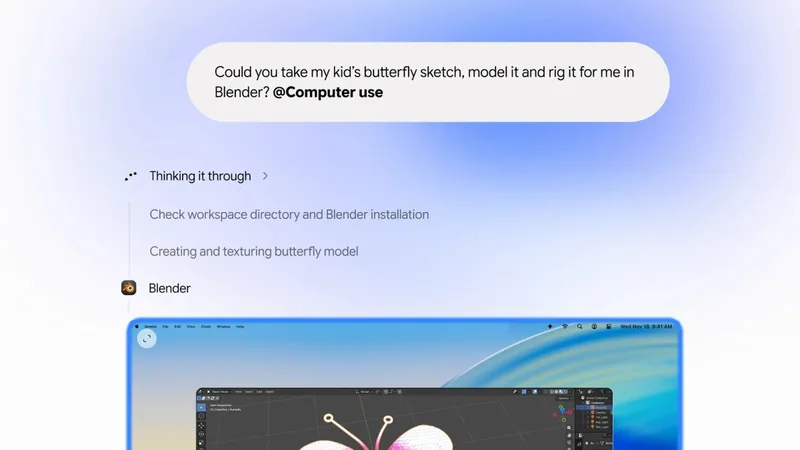
Google announced Thursday that it is bringing computer use to the Gemini desktop application on macOS, letting the AI complete tasks for users by navigating native Mac apps and browsing websites in the background.
Per the article's summary, the agent is pitched at organizing files, filling out forms, and tackling multistep workflows.
TechCrunch frames Google as late here — OpenAI, Anthropic, and Meta have offered agentic features in their desktop apps for some time. Google only this week announced the broader rollout of Gemini's "Tasks," which helps users sign into websites, make purchases, or book appointments.
Google also only recently began admitting early testers to its revamped "CC" agent, announced in September, aimed at helping families stay organized across email, calendars, chats, and tasks.
Why it matters for an independent practice: Form-filling and multistep workflows is exactly the shape of a practice's unglamorous back-office load — intake paperwork, portal re-keying, directory and listing updates across a dozen sites. The buildable test for MMR work is to point it at marketing admin first (listings, reporting pulls, asset organization), on a machine with no PHI on it, because an agent that can see the screen can see whatever is open on the screen. Read this one together with the Muse item above before you grant it access.
ONC and CMS are recruiting practices to test electronic prior authorization workflows ahead of a Jan. 1 support requirement
Medical Economics · November 18, 2026Practice operations
Per the Morning Medical Update by Austin Littrell (fact-checked by Keith A. Reynolds), ONC/CMS are enrolling payers, providers, hospitals, EHR vendors, and intermediaries to validate ePA workflows for high-volume services.
Participation is voluntary and does not imply certification or compliance — joining the test is not an attestation.
The interoperability and prior authorization rules will require ePA support by Jan. 1 for Medicare Advantage, Medicaid managed care, CHIP, and federally facilitated exchange plans.
Why it matters for an independent practice: Not an AI story, but it is the adjacent-and-actionable kind: a dated federal opening a small practice can walk through before the Jan. 1 date lands on it. Getting into the validation cohort is how an independent practice finds out whether its EHR vendor is actually ready — rather than discovering it in January, when every automation layer you plan to build on prior auth depends on the pipe working.
Probably Genetic's CEO makes the case that AI can find undiagnosed genetic conditions and route those patients to treatment
HIMSS TV, via Healthcare IT News · November 16, 2026Practice operations
A HIMSS TV interview with Lukas Lange, CEO and cofounder of Probably Genetic, published Nov. 16 at 9:21 AM.
The publisher's description says the segment covers how AI can help identify undiagnosed genetic conditions while more effectively connecting patients with appropriate treatment.
Healthcare IT News files it under Analytics, Artificial Intelligence, Government & Policy, Population Health, and Precision Medicine.
Thinness disclosed up front: this is the channel's own description, not a transcript, and no runtime or specific findings are stated — treat it as what the video covers, not what it concludes.
Why it matters for an independent practice: The diagnostic-odyssey patient is the same person who lands in a regenerative or longevity practice after years of unexplained symptoms. Worth ten minutes for how the find-the-undiagnosed pitch is being framed to health systems — and because the referral-routing half of that pitch is the part a specialty practice should be building its own intake around.