OpenMatter's founders say AI agents need a cryptographic kill switch because ordinary guardrails "fail at machine speed"
November 21, 2026 · 4 items
OpenMatter's founders say AI agents need a cryptographic kill switch because ordinary guardrails "fail at machine speed"
Healthcare IT News · November 20, 2026Practice operations
This week's HIMSSCast features Renee Davis (chief business officer) and Ada Anderson (chief technical officer), cofounders of OpenMatter Network, on letting privacy-bound organizations collaborate without exposing raw data — in a secret-share service split across many decentralized compute parties, a hacker would have to compromise multiple servers and then reverse the secret computation.
Their argument for agents: AI can safely participate in multi-party computation because of cryptographic audit trails, and an agent that stops following privacy and security policies can be quickly cut off from sensitive data — a kill switch they call critical for healthcare.
Davis's framing is the quotable part: traditional cybersecurity guardrails "fail at machine speed" these days, while cryptographic verification "really puts the brakes on AI in a way that's tangible and auditable and provable."
Listed talking points also include post-quantum cryptography migration and how healthcare is falling behind on "harvest now, decrypt later" attacks.
Why it matters for an independent practice: Two questions to put to any vendor whose agent will touch patient data: what is the mechanism that cuts this agent off mid-task, and is the record of what it touched kept somewhere we control rather than inside your product? That is the agent/data-stewardship conversation to have before signing, not after.
Superhuman's Go assistant goes proactive — watching your calendar and email and drafting replies in your writing style
TechCrunch · November 19, 2026Buildable AI
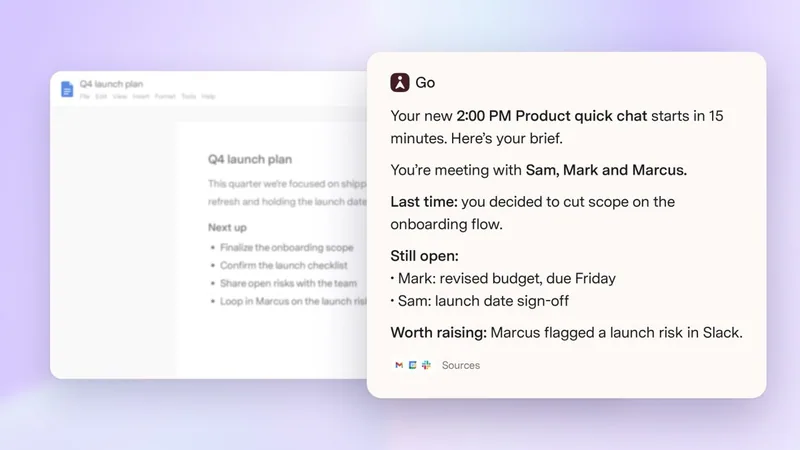
Superhuman (formerly Grammarly) is making Go its central agent and extending it into Docs and Mail; it works inline with the cursor, like Grammarly did, and also manages other agents.
The agent is now proactive: per TechCrunch it "looks for your schedule, keeps an eye on your email, and even drafts responses," and learns the user's writing style to respond accordingly in email and Docs.
Onboarding has been revamped so users connect preferred tools and load context about their work upfront, and the company is adding 20 new connected agents through its Go SDK — including DeepL, Legora, Amplitude, Databricks, and Blackboard.
TechCrunch notes some of the company's AI features have faced criticism previously, linking its own March 2026 piece on Grammarly's "Expert Review."
Why it matters for an independent practice: This is the shape of assistant a practice manager will install without asking anyone: it ingests the whole inbox to draft in your voice. For an independent practice that means front-desk email — appointment requests, lab questions, insurance threads — becomes training context for a third-party agent. Decide before rollout which mailboxes it may connect to, and keep anything PHI-adjacent out until there's a BAA in writing.
FBI warns an open-source AI hacking tool, Artex, breached networks in "under three hours"
TechCrunch · November 16, 2026Buildable AI
The FBI is warning about Artex, an open-source AI hacking tool that it says was used to breach networks in "under three hours."
Per TechCrunch's summary of the bureau's warning, the tool was used in cyberattacks targeting a U.S. IT giant and the South Korean financial industry.
Reported by security editor Zack Whittaker, Nov. 16, 2026.
Why it matters for an independent practice: Read it next to the HIMSSCast item above: the defensive claim is that guardrails "fail at machine speed," and here is the offensive side of the same clock. A small practice with no security staff should treat three hours as the realistic time-to-compromise and plan accordingly — current backups, MFA on remote access, and a named person who can pull the plug — rather than assuming a breach unfolds over days.
A Taiwanese hospital's superintendent frames AI adoption around patient need, in a clip on cutting cardiac ischemia detection time
HIMSS TV via Healthcare IT News · November 17, 2026Practice operations
Filmed for HIMSS26 APAC, the clip features Superintendent Dr. Der-Yang Cho of China Medical University Hospital; the publisher's title states the hospital's AI reduces time to detect cardiac ischemia.
The only claim the description itself makes is Cho's stated criterion: addressing patients' needs is the top priority for AI adoption at their hospital.
Disclosure on thinness: this is a one-line publisher description, not a transcript — no runtime, no detection-time figures, and no study are given, so the magnitude of the improvement is not stated anywhere in what's available.
Why it matters for an independent practice: The adoption test worth borrowing is the one Cho names — start from the patient need, not the tool. For a regen-med or independent practice evaluating an imaging or triage AI, the question to ask the vendor is the same one implied here: which patient-facing delay does this shorten, and by how much? If they can't answer in minutes saved, it isn't a clinical tool yet.